Summit
AI Regulation Ban: The Two Things People Mean
In the US an AI regulation ban means banning the states from regulating. In the EU it means the uses Article 5 forbids. Both are live in 2026.
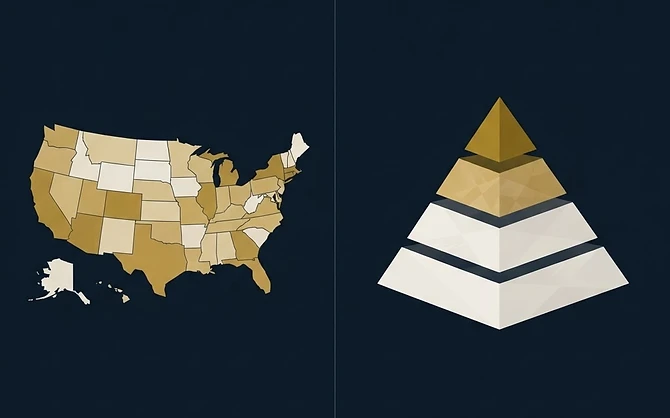
An AI regulation ban is one phrase attached to two policies that point in opposite directions, and in 2026 both are running at once. In Washington it means banning the regulators: an attempt to stop American states from writing AI law at all. In Brussels it means the opposite, a list of AI uses that are themselves forbidden, with the highest fines in the world attached. Read a headline without knowing which sense is in play and you can come away believing the rules just disappeared when they just arrived, or the reverse.
The American usage entered general circulation on 1 July 2025, when the Senate voted 99 to 1 to strike a ten-year federal moratorium on state AI regulation from the administration's tax and spending bill. The European usage is older and more literal. Article 5 of the AI Act carries a list of prohibited practices that, per Article 113(a) of the Act, came into force on 2 February 2025.
This piece takes both readings in turn, because most coverage takes only one.
Reading one: banning the regulators
Three attempts, two failures and an executive order
The moratorium stripped in July 2025 was the first attempt. The second came that November, when the White House pushed to attach a state moratorium to the National Defense Authorization Act. It fell short, with senior lawmakers rebuffing the language as a nonstarter, largely because they were unwilling to impose a blanket ban on state action while no national framework existed to replace it.
The third attempt skipped Congress. On 11 December 2025 the President signed Executive Order 14365, Ensuring a National Policy Framework for Artificial Intelligence.
What Executive Order 14365 actually instructs
Read the instrument rather than the coverage and it does three concrete things. It directs the Attorney General to stand up, within 30 days, an AI Litigation Task Force whose sole responsibility is to challenge state AI laws, on grounds including unconstitutional regulation of interstate commerce. It directs the Secretary of Commerce, within 90 days, to publish an evaluation identifying onerous state laws, and specifically to flag laws that require AI models to alter their truthful outputs. And it ties money to the outcome: a Policy Notice must make states carrying those laws ineligible for non-deployment funds under the Broadband Equity Access and Deployment programme. The order's own text names a Colorado law banning algorithmic discrimination as its example of the problem.
That last mechanism is the one with teeth, and its scale is easiest to see in the state it targets hardest. California, which has passed more AI laws than any other, has up to 1.8 billion dollars of broadband funding exposed, much of it already committed to specific projects. The same reporting counts more than 70 AI laws passed by 27 states during 2025.
Where it bites, and where it was told not to
The order is not a blanket ban even on its own terms. At the signing, several areas were named as outside the recommended preemption: child safety protections, data centre infrastructure, and state procurement of AI. The same order tasks the White House AI adviser and the OSTP director with recommending a federal law that would preempt state AI regulation properly, which is an admission of what an executive order cannot do by itself.
Six months on, the ban did not take
By June 2026 the answer to whether it worked was in. States are increasingly regulating anyway, with Congress still stalled, and the new bills concentrate on how chatbots interact with children, how employers use AI systems, and what developers must do to prevent an AI-caused catastrophe. Lawmakers stepped back from the broad developer-liability bills that governors had vetoed, and came back with narrower ones.
Two things explain why the order underperformed. The first is legal. Analysis of the preemption theories notes that an executive order cannot preempt state law by itself, that the administration is relying on litigation and funding conditions instead, and that the theories it is likely to advance face significant obstacles in court.
The second is that the laws it was aimed at had already landed. MIT Technology Review's read on 2026 is that the battleground shifts to the courts: New York's RAISE Act was signed on 19 December 2025, eight days after the order, and California's SB 53 took effect on 1 January 2026 regardless. The volume behind that is the real obstacle. The National Conference of State Legislatures counted more than 1,000 state AI bills introduced in 2025, with nearly 40 states enacting over 100 laws. Cornell's James Grimmelmann expects the order to be used against a fairly small number of provisions, mostly on transparency and bias. Margot Kaminski of Colorado Law puts the administration's position more bluntly: it is on thin ice.
There is a counterintuitive result buried in that reporting. The states most likely to back off are not California and New York, which have the budgets and the political incentive to fight, but Republican states that cannot afford to lose rural broadband money. A funding condition disciplines the jurisdictions that need the funding.
The bill that would ban only half of it
On 4 June 2026 the preemption argument acquired an actual text. Representatives Jay Obernolte and Lori Trahan released the Great American AI Act as a discussion draft, and its preemption clause draws one line that matters more than the rest: it would preempt state laws specifically regulating the development of an AI model, for three years, and explicitly would not touch laws regulating use or deployment. California's AB 2013, which requires developers to publish summaries of their training data, and part of SB 942 on content watermarking, are named as casualties.
That distinction is the most useful thing in the whole debate for anyone building. It decides whether a rule follows the model or follows the product. A training-data disclosure duty attaches to the model and would be frozen. A duty about how your chatbot speaks to a minor attaches to deployment and would survive.
The 269-page draft is not a deregulation bill in the simple sense: it pairs the freeze with semi-annual third-party audits for the largest developers, and leaves states their civil rights, labour, copyright, CSAM and consumer privacy authority. It also drew near-immediate rejection from labour unions, consumer advocates and a House commission, which is a fair signal of its odds. It has not been formally introduced.
Reading two: the uses that are banned outright
What Article 5 forbids
Cross the Atlantic and the phrase inverts. The EU AI Act sorts systems by risk, and the top tier is not regulated but prohibited. Article 5 bans, among other practices, placing on the market or using an AI system that deploys subliminal techniques beyond a person's consciousness, or purposefully manipulative or deceptive techniques, where the effect is to materially distort behaviour by appreciably impairing someone's ability to make an informed decision, in a way likely to cause significant harm.
The prohibitions attach to placing on the market, putting into service, or use within the Union. Not to where the provider is incorporated. That is why a team in Jakarta or Austin can be inside the scope of a European ban without ever opening a European office.
Three of the prohibitions bind private deployers directly rather than only model providers: untargeted scraping of facial images from the internet or CCTV to build or expand a facial recognition database, emotion recognition in workplaces and educational institutions, and biometric categorisation that infers sensitive characteristics such as race, political opinion or sexual orientation. An employer running an off-the-shelf tool can breach these without writing a line of model code.
What it costs to breach
Breaching the Article 5 prohibitions carries a ceiling of 35 million euro or 7 percent of total worldwide annual turnover, whichever is higher, which is the highest AI penalty in the world and sits above the GDPR maximum. For a large group, the AI Act is now the more expensive exposure of the two.
The ninth prohibition
The most common misreading of European AI law in 2026 is that it is being rolled back. The Digital Omnibus did defer obligations, moving the Annex III high-risk duties to 2 December 2027. But according to one regulation tracker's log of the instrument, it also added a ninth Article 5 prohibition, covering systems that generate non-consensual sexually explicit content or child sexual abuse material, such as nudification apps, taking effect in December 2026, and centralised more oversight in the AI Office. A regulation that lengthens its own ban list is not being repealed. It is being resequenced.
Most of the world has neither
Outside those two poles, there is no ban list to look up at all. A comparative map of AI regulation by country puts South Korea's AI Basic Act in force from 22 January 2026 with administrative fines topping out around 30 million won, roughly 20,000 US dollars. Japan's AI Promotion Act, in force since September 2025, is explicitly non-punitive and carries no monetary penalties at all. The United Kingdom has no AI statute. Brazil's risk-based bill passed the Senate and has sat in the Chamber of Deputies since. Canada's AIDA died on the order paper in January 2025 and was not reintroduced.
So the honest answer to what is banned is jurisdictional. It depends entirely on which market a system is placed on, and for most of the world's markets the answer is currently nothing specific to AI, with general privacy, consumer and criminal law doing the work instead.
The third option nobody argues about
Both readings of the phrase share an assumption: that the choice is between writing rules and preventing rules from being written. There is a third posture, and it gets almost no airtime because it produces no headline. Bound the experiment instead of the technology. Give a defined cohort a defined perimeter, a defined duration and a regulator in the room, then legislate from what happened rather than from what was projected.
That is the premise the EX Future Summit is built on, and it is why the format is unusual: a single continuous thirty-hour broadcast running between Las Palmas and Bali, twelve hours apart, from 18 to 20 November 2026, with free online attendance for verified researchers and students. One room sits inside the strictest AI jurisdiction on earth and the other sits in one with no AI statute at all, in the same session, which is a difficult thing to arrange at a single-city conference.
The nine-track programme carries dedicated Government and AI Ethics tracks for exactly this argument, and the concrete version of the sandbox posture is on the agenda rather than in the abstract: Bali Province's digital residency sandbox opens a cohort at the summit, granting a ninety-day residency, a policy pilot lane and access to municipal data. That is a small thing next to an executive order. It is also the only instrument on this page that produces evidence rather than a position.
What to do with this if you are building
Three practical consequences follow, and none of them require picking a side.
First, your European exposure does not depend on where you sit. If the system is placed on the EU market, Article 5 reaches it, and the three deployer-facing prohibitions reach you even when someone else built the model. Working out what that means in practice is the substance of AI regulatory compliance rather than a box to tick.
Second, in the United States, deployment rules are the more durable planning assumption than development rules. Every preemption attempt so far has aimed at the development half, and the June 2026 draft says so explicitly. The rules governing how your product behaves in front of a user have not been on anybody's chopping block.
Third, the direction of travel is not deregulation, it is divergence. That is a strategic question rather than a compliance one, and it is closer to the argument about sovereign AI than to any of the bills above. If you want the case for and against rules on the merits, we set out the evidence on should AI be regulated at all. If the distinction between the two instruments in play here is what you need, governance and regulation are not the same instrument is the shorter version. And for the sandbox posture in detail, see islands as regulatory sandboxes.
FAQ
Is AI regulation banned in the United States?
No. Two congressional attempts to ban state AI regulation failed, and Executive Order 14365 is an instruction to federal agencies to challenge and defund state AI laws, not a law that voids them. Six months after it was signed, states were legislating on AI more, not less.
What happens to a state AI law if a federal preemption bill passes?
It depends which half of the stack the law regulates. The June 2026 discussion draft would preempt only state laws governing how models are developed, for three years, and explicitly leaves use and deployment to the states. A training-data disclosure law would be frozen; a chatbot-and-minors law would not.
Does the EU ban apply to a company based outside the EU?
Yes, where the system is placed on the Union market, put into service there, or used there. Article 5 attaches to market placement rather than to where the provider is incorporated, so a non-EU developer selling into Europe is in scope.
Has any country banned artificial intelligence outright?
No. Every prohibition in force anywhere attaches to a specific practice, not to the technology. Even facial recognition, the most heavily restricted category, is not banned outright by any country; the rules govern which mode of it you run.
Which is stricter, the EU ban list or a US state AI law?
The EU list, by a wide margin on penalty. Article 5 breaches reach 7 percent of worldwide turnover, while US state AI laws are enforced mainly by attorneys general with per-violation civil penalties. The US patchwork is broader in what it touches; the EU regime is heavier in what it costs.