Summit
Best AI for Weather Forecasting: 7 Models by Use Case
The best AI for weather forecasting depends on the job. AIFS, GraphCast, GenCast, Aurora, WeatherNext 2 and NOAA's AIGFS compared on published scores.
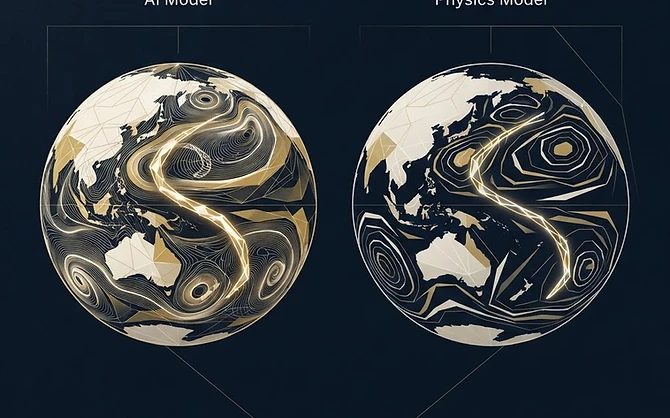
Ask which is the best AI for weather forecasting and you will find a different winner in every paper. GraphCast tops one benchmark, FengWu another, Pangu-Weather a third. None of them is lying. They are answering different questions, on different metrics, in different parts of the world.
So this guide does not crown one model. It ranks seven by the job you need done, and by the question most comparisons skip: can you actually get your hands on it? It is written for the people who have to choose: researchers picking a baseline, agencies and utilities buying forecast data, founders building a product on top, and investors trying to tell a moat from a press release.
The short answer: best for what?
If you only read one section, read this one.
- Best open, operational model: ECMWF's AIFS. Free data, open weights, run every six hours by a major forecasting centre.
- Best deterministic benchmark: Google DeepMind's GraphCast, still the reference most new models are measured against.
- Best for probabilities and risk: GenCast and its successor WeatherNext 2, if you can work inside Google Cloud.
- Best for more than weather: Microsoft's Aurora, which also forecasts air quality, ocean waves and cyclone tracks.
- Best for US operational guidance: NOAA's new AI suite, especially the hybrid HGEFS ensemble.
- Best regionally in East Asia: FengWu, in at least one independent test.
- Best for record-breaking extremes: none of them. Physics still wins there.
The catch is that these rankings move. A five-model study over East Asia and the Western Pacific put FengWu first, FuXi and GraphCast next, and Pangu-Weather last, with ECMWF's physics-based IFS in the middle. A study of US West Coast atmospheric rivers found almost the reverse order among the models it tested. Keep that in mind for everything below.
The seven models worth knowing
ECMWF AIFS: best open, operational choice
The AIFS is the safest default for most serious users, because it is the only one that is open, operational and backed by an institution that will still be running it next year. Its deterministic version, AIFS Single, has run operationally since 25 February 2025, and the ensemble version, AIFS ENS, since 1 July 2025; both were upgraded to version 2 on 12 May 2026. Output is licensed CC-BY-4.0, which means you may redistribute it and use it commercially with attribution.
ECMWF describes it as the first global data-driven model to join the operational service of an international meteorological centre. It produces a full 15-day forecast in minutes, and the model weights for both versions are on Hugging Face if you want to run it yourself. The ensemble has 229 million parameters at a resolution of roughly 30 km, and in its current form generates a 51-member, 15-day forecast four times a day. At launch, ECMWF reported up to 20% better tropical cyclone tracks and about 1,000 times less energy per forecast than its physics model.
Choose it if you want a free, citable, production-grade baseline, or you are building a product and need a licence you can actually ship on.
Google DeepMind GraphCast: the deterministic benchmark
GraphCast made the field take AI seriously. It forecasts hundreds of variables ten days ahead at 0.25 degree resolution in under a minute, and in Science it beat the leading operational deterministic systems on 90% of 1,380 verification targets.
Independent work broadly backs that up. A peer-reviewed comparison in Geoscientific Model Development found GraphCast significantly outperformed ECMWF's HRES across all regions and lead times, and ran 5% to 20% ahead of Pangu-Weather on 10-day 2 m temperature forecasts.
Choose it if you need the reference point reviewers will expect you to compare against. You do not have to run it yourself: ECMWF runs GraphCast daily alongside the AIFS and publishes the charts and scores on OpenCharts.
GenCast and WeatherNext 2: best for probabilities
A single forecast tells you nothing about how confident to be, and confidence is what an insurer, a grid operator or a flood agency actually pays for. GenCast was built for that. It generates a 15-day global ensemble in 8 minutes and, in Nature, beat ECMWF's ensemble, widely treated as the world's best, on 97.2% of 1,320 targets.
Its commercial successor is WeatherNext 2. Google says it produces hundreds of possible scenarios in under a minute on a single TPU, runs 8 times faster than before, and beats the previous WeatherNext model on 99.9% of variables and lead times. The data is available in Earth Engine and BigQuery, with early access on Vertex AI, and it already powers weather in Search, Gemini, Pixel Weather and the Maps Platform Weather API.
Choose it if your decision depends on the odds rather than the most likely outcome, and you are comfortable with a Google Cloud dependency.
Microsoft Aurora: best for more than weather
Aurora is a foundation model, pretrained on over a million hours of Earth system data and then fine-tuned per task. The Nature paper reports that its 10-day weather forecasts at 0.1 degree beat state-of-the-art numerical models on 92% of targets. Its 5-day cyclone tracks beat seven operational centres on 100% of targets, its air pollution forecasts beat numerical chemistry models on 74%, and its ocean wave forecasts on 86%.
Choose it if your problem is not just temperature and rain: shipping, offshore energy, air quality or coastal risk. But read the next section before trusting its RMSE alone.
NOAA AIGFS, AIGEFS and HGEFS: the US operational suite
In December 2025 NOAA put three AI models into operations. AIGFS uses up to 99.7% less computing than its traditional counterpart. AIGEFS, the AI ensemble, extends useful forecast skill by 18 to 24 hours over the physics-based GEFS in early results. The most interesting is HGEFS, a hybrid "grand ensemble" that mixes AI and physics members and, in initial testing, consistently outperforms both the AI-only and physics-only systems.
Choose it if you work in the US public weather enterprise, or you want evidence that hybrids, not pure AI, may be where operational forecasting settles.
Pangu-Weather and FengWu: the regional contenders
Huawei's Pangu-Weather remains a useful comparison point, partly because of its quirks. Run in different climate states, it showed a steady global cold bias of about 0.03 K per day, where AIFS and GraphCast did not.
FengWu came out on top in the East Asia study above, with the most accurate track forecasts for 2023's typhoons. It also had the largest intensity errors. That split is the whole lesson of this article in one model.
Choose them if you are working in East Asia or need diverse members for a multi-model ensemble. In that same study, a plain average of all five models performed about as well as FengWu alone.
Comparison table: skill, speed and access
| Model | Builder | Headline published result | Speed | Access |
|---|---|---|---|---|
| AIFS Single and ENS | ECMWF | Up to 20% better cyclone tracks | 15 days in minutes | Open data, open weights |
| GraphCast | Google DeepMind | Beats operational systems on 90% of 1,380 targets | 10 days in under a minute | Research model, daily charts via ECMWF |
| GenCast | Google DeepMind | Beats ECMWF ensemble on 97.2% of 1,320 targets | 15-day ensemble in 8 minutes | Research |
| WeatherNext 2 | Beats predecessor on 99.9% of variables and lead times | Hundreds of scenarios in under a minute | Earth Engine, BigQuery, Vertex AI | |
| Aurora | Microsoft | Beats numerical models on 92% of weather targets | Orders of magnitude below physics | Research model, daily charts via ECMWF |
| AIGFS, AIGEFS, HGEFS | NOAA | AIGEFS adds 18 to 24 hours of skill | Up to 99.7% less compute | US operational |
| FengWu | Academic research model | Best of five models in East Asia, 2023 | Not compared here | Research |
Every number in that table is the builder's own or a peer-reviewed result, and each is measured differently. They are not comparable to each other, which is exactly why "best" needs a use case attached.
Why the leaderboard keeps changing
RMSE rewards smooth forecasts
Most headline scores use root mean square error. It is a fair measure of average accuracy, but a model that hedges toward a smooth, blurry field can score well on it while missing the sharp features that matter.
Two results show how far that can go. NVIDIA researchers built lagged ensembles from deterministic runs and found GraphCast and Pangu-Weather tied on probabilistic skill, even though GraphCast clearly wins on deterministic scores. And across 152 forecast cycles of US West Coast atmospheric rivers, Aurora had the best error scores on individual variables yet the worst skill at actually detecting the rivers. ECMWF's physics-based HRES led detection for the first four days, and only Pangu-Weather matched it after that.
Region and season change the winner
The East Asia study evaluated one region over one season, June to November 2023, and produced a ranking that contradicts the global ones. That is not a flaw in the study. It is a warning that a global average can hide a model that is weak exactly where you operate. Before you pick, find or run an evaluation for your own region and the phenomenon you care about.
Where no AI model is best yet
One result cuts across every model on this list. A 2026 study in Science Advances tested GraphCast, Pangu-Weather and FuXi, plus operational variants, against ECMWF's HRES on record-breaking heat, cold and wind. HRES won consistently, across nearly all lead times. The AI models underestimated both how often records occur and how extreme they get.
We cover why that happens, and why it matters more as the climate warms, in our piece on AI in climate change prediction. The practical takeaway for a buyer is short: if your use case is early warning for unprecedented events, the best AI weather model today is one that runs next to a physics model, not instead of it. NOAA's hybrid result points the same way.
How to choose for your project
Work through these in order.
- Name the phenomenon. Temperature, precipitation, wind, cyclones, atmospheric rivers or air quality. Then look for an evaluation on that, not on a global average.
- Decide deterministic or probabilistic. If you price risk, you need an ensemble: AIFS ENS, GenCast, WeatherNext 2 or AIGEFS.
- Check the licence before the leaderboard. A research model you cannot deploy is a paper, not a product. AIFS's CC-BY-4.0 terms are the clearest on this list.
- Test on your own ground truth. A global benchmark score is not a substitute for checking the model against the observations your decisions actually depend on.
- Keep a physics or hybrid fallback for extremes. Until the record-breaking gap closes, this is risk management, not conservatism.
For founders and investors, the same list doubles as diligence. A startup "using AI for weather" is usually building on one of these seven models. The questions worth asking are which one, under what licence, and what they add on top. For the mechanics behind those answers, start with how AI weather forecasting works and our overview of AI in weather forecasting.
These are exactly the conversations the EX Future Summit's Research and Impact tracks are built for. The summit runs as a thirty-hour broadcast between Las Palmas and Bali on 18 to 20 November 2026, so a forecaster in Jakarta and a funder in Madrid can be in the same room at a sensible hour. For the adaptation side of the story, where these forecasts turn into decisions, see AI in climate change adaptation.
FAQ
Which AI weather model is the most accurate?
There is no single most accurate model. GraphCast leads many deterministic benchmarks, GenCast and WeatherNext 2 lead on ensemble forecasts, and FengWu ranked first in an East Asia comparison. The answer depends on the variable, the region and the metric you score with.
Can I use an AI weather model for free?
Yes. ECMWF publishes AIFS forecasts as open data under a CC-BY-4.0 licence that allows commercial use, and the model weights are on Hugging Face. ECMWF also runs GraphCast, Pangu-Weather, Aurora and FourCastNet daily and shows their charts on its OpenCharts platform.
Is AI better than traditional weather forecasting?
For average conditions, the leading AI models now match or beat the best physics-based systems on most published scores, at a small fraction of the computing cost. For record-breaking heat, cold and wind, physics-based forecasts still perform better, which is why operational centres run both.
What AI does Google use for weather?
Google uses WeatherNext 2, built by Google DeepMind and Google Research. It powers forecasts in Search, Gemini, Pixel Weather and the Google Maps Platform Weather API, and its data is available to developers through Earth Engine and BigQuery.