Summit
What Countries Offer Digital Residency? The Full List
Which countries offer digital residency in 2026: Estonia, Azerbaijan, Lithuania, Ukraine, Palau and Bali, with fees and what each actually grants.
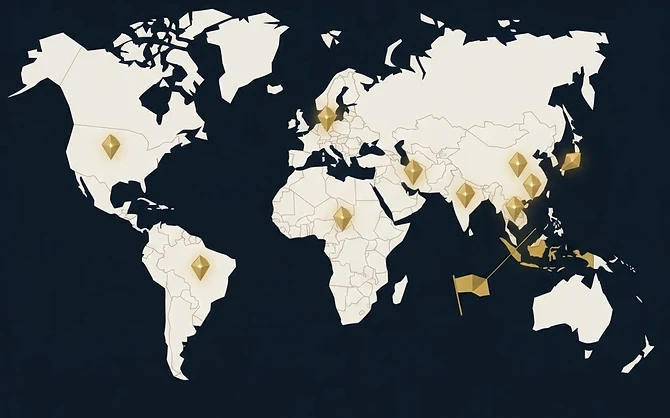
Ask what countries offer digital residency and most answers come back as a ranking for nomads. This one is written for the other reader: the ministry official or agency head asking what, precisely, each state has decided to issue to a foreigner it will never meet, and what that decision cost or earned. Five national programmes are live, one provincial pilot is opening, and several announced schemes have not materialised. The useful comparison is not which is best. It is which rights each one actually confers.
Which countries offer digital residency today
Six jurisdictions issue something a reasonable person would call digital residency. In order of launch: Estonia (2014), Azerbaijan (2018), Lithuania (2021), Palau (2021), Ukraine (2024) and, as a provincial pilot rather than a national statute, Bali. Estonia's own programme office, which keeps a close eye on its imitators, records that Portugal, Croatia and Singapore have all been discussed and none has come to fruition, and declines to count Liberland because it is not a state. Several ranking blogs still list Portugal's scheme, which was announced in 2020 and remains unlaunched.
| Jurisdiction | Since | Fee | Digital ID | Form a company | Bank account | Tax regime | Physical stay |
|---|---|---|---|---|---|---|---|
| Estonia | 2014 | €150 | Card, in-person pickup | Yes, online | Via marketplace providers | Standard Estonian company tax | None |
| Azerbaijan | 2018 | Package fee | Token or Asan Imza SIM | Yes, online | Yes | Standard, startup reliefs | None |
| Lithuania | 2021 | €90 | Card, two in-person visits | Not with the card alone | Not with the card alone | Not applicable | None |
| Palau | 2021 | $248 a year | Card by mail plus Web3 ID | No | No | None attached | Extended tourist stay |
| Ukraine | 2024 | Free | Diia e-signature | Sole proprietor only | Yes, remote | 5% of revenue | None |
| Bali (province) | Pilot | Not published | Via sandbox cohort | Not the point | Not the point | Not the point | Ninety days |
The rest of this piece walks through each row with the issuing government's own numbers wherever they exist.
What digital residency is, and what it never grants
The cleanest legal definition sits in Lithuanian statute. Its Law on the Legal Status of Aliens defines an electronic resident as a foreigner who seeks access to the administrative, public or commercial services provided in the Republic by electronic means and who has been granted that status under the law. Nothing in that sentence concerns borders. For a longer treatment of the concept, see what digital residency is.
Three things follow, and every programme on the list shares them. Digital residency does not grant the right to enter or live in the country. It does not make the holder a tax resident. It does not lead to citizenship. Estonia, which also runs a separate digital nomad visa from August 2020 lasting twelve months, is explicit that e-Residency alone does not grant the right to live in Estonia. The only entry below that pairs a right to stay with the digital status is Bali's pilot, and that is the point of it.
Estonia: the reference programme
Estonia invented the category and still defines it. The official dashboard counts more than 144,000 e-residents and more than 44,000 Estonian companies founded by them, with over a hundred service providers on its marketplace, last updated on 22 September 2026.
The fiscal case is now a matter of record. In 2025 the programme generated €124.9 million for the state: €54.5 million in labour taxes, €66 million in income tax on distributions such as dividends, and €4.3 million in state fees. That year 13,828 people became e-residents, a six-year high, and they founded 5,556 companies, up 15 percent. The programme office puts the cumulative total at more than 135,000 people from 185 countries, with roughly 63,000 five-year cards in circulation, and notes that e-residents now start one in every five new Estonian companies. The economy minister's framing was that every euro invested returned more than twelve.
The mechanics are deliberately plain. An applicant pays €150 and spends about thirty minutes online, waits up to thirty days for an identity check, then two to five weeks for delivery, and collects the card in person at a pickup location with the same passport used to apply. That plastic card is now described by the programme's own managing director as its biggest obstacle, and the 2026 to 2029 strategy aims at card-free, fully mobile issuance once a biometric app and a legislative amendment are in place.
Azerbaijan: e-Residency and the first m-Residency
Azerbaijan was second. Its Digital Trade Hub describes itself as the world's second country after Estonia to offer e-Residency and the first to offer m-Residency. The two statuses are functionally identical: an e-resident receives a token for authentication and signatures, an m-resident a special Asan Imza SIM card that does the same job. Either can establish a company fully online, reach business banking and payment providers, sign documents, file tax and customs declarations and register employees. Processing takes up to a month and the credential is collected in person.
The scale is modest. The hub itself was created by presidential decree on 22 February 2017, and the government reports that between 2018 and 2020 it issued virtual identification numbers and e-signature certificates to over a hundred foreign nationals from thirty countries. Set against Estonia's annual intake, that is a pilot, which is a reasonable thing for a programme to be.
Lithuania: an EU card that still does less than Estonia's
Lithuania's card is cheaper than Estonia's, at a state fee of €90 for the card with its certificate and e-signature. The Migration Department's own leaflet describes it as a tool for electronic identification and electronic signature that lets the holder use administrative, public or commercial remote services and create qualified electronic signatures. Legally that is a strong credential, recognised across the European Union's trust-services framework.
In practice the programme has lagged. Estonia's programme office observes, not disinterestedly, that Lithuania struggled to grow because the process requires two visits in person. Independent reviewers add that as of 2025 Lithuanian e-residents cannot register a company or open a bank account using the card alone, because the surrounding legal and banking plumbing is not finished. The lesson for any agency copying Estonia is that the card is the easy part.
Ukraine: uResidency, free, 5 percent on revenue
Ukraine's programme is the newest national one and the most sharply targeted. The Ministry of Digital Transformation launched uResidency in September 2024 at Lviv IT Arena, opening first to citizens of India, Pakistan, Thailand and Slovenia. It charges no registration fee and no monthly contribution. The one physical step is identification at a Ukrainian consulate in the applicant's own country.
What it grants is narrower than Estonia's. The programme terms give the e-resident the right to register as a private entrepreneur, a sole proprietor rather than a limited company, to open a Ukrainian bank account by video verification, and to pay 5 percent of income up to a threshold the terms put at roughly €200,000, with 15 percent above it. The partner bank acts as tax agent, withholding from each receipt and filing the returns, so the entrepreneur keeps no books. The programme's own tax explainer is careful on one point that blogs miss: the 5 percent is calculated on revenue, not profit, and it states the upper band as beginning at €180,000 a year. The two official pages disagree on the threshold; a prospective applicant should ask the ministry which figure is current. The same page reports more than three hundred foreigners had applied.
Palau: a government ID, not a company
Palau's Digital Residency, launched in 2021 with Root Name System as the technology provider, is the entry most often misunderstood. Estonia's comparison records that Palau has more than 4,700 digital residents, that it is currently not possible to register a company in Palau with the status, and that e-Corporations sit on the roadmap. The programme is priced at $248 for one year, $1,039 for five and $2,039 for ten, with the physical card posted to the holder and acceptance by exchanges and banks varying from one institution to the next.
The provider's own front page positions the card for check-in, boarding, rentals and know-your-customer checks at exchanges, which is an honest description. Holders also receive an extended tourist stay in Palau of up to 180 days, the only physical perk among the national programmes. Whether that package is worth the fee is a separate question, taken up in whether Palau digital residency is legitimate. As a matter of what the state grants, it is an identity document with a price, and nothing more yet.
Bali: digital residency as a policy sandbox
The sixth entry is not a national law but a provincial experiment, and it inverts the model. Bali Province's digital residency sandbox grants a ninety-day residency, a policy pilot lane and access to municipal data, with a cohort opening at the summit this November. Where the five national programmes carefully exclude any right to be present, Bali's pairs presence with permission to test something under a regulator's eye. It is closer to the family of instruments described in islands as regulatory sandboxes for AI than to Estonia's company-formation machine. It is also a pilot, with no published fee or statute, and should be read as one.
Why the list is a small-state list
Look at who is on it. Estonia has 1.3 million people. Palau has around 18,000 across 244 islands. Bali is a province. Lithuania and Azerbaijan are mid-sized states that copied a small one. The pattern is not an accident: a state with a small domestic user base has the strongest reason to extend its digital services to people outside its borders, and the least to lose if the experiment is modest.
For an agency considering a programme, the six rows suggest three design decisions that matter more than the branding.
- Identity only, or company formation? Palau and Lithuania today issue an identity. Estonia, Azerbaijan and Ukraine attach a legal vehicle to it, and that is where the revenue comes from.
- Where does the body have to be? Lithuania asks for two visits, Estonia for one pickup, Azerbaijan for one collection, Ukraine for one consulate appointment, Palau for none. Each extra appearance is a measurable drag on uptake, which is why Estonia is trying to remove its last one.
- Name the tax regime before launch. Ukraine's flat 5 percent with the bank as agent is the clearest offer on the list. Lithuania's silence on the question is one reason its card does less.
There is a fourth consideration that belongs to policy rather than product. A digital resident uses the issuing state's identity infrastructure, and in some designs its data, from abroad. Who controls that stack is the question behind what sovereign AI means for a small state, and it is worth settling before the first card is posted.
These questions are the working material of the Government track at the EX Future Summit, which treats sovereign compute, digital residency and the island as a policy sandbox as one subject rather than three. The summit runs from 18 to 20 November 2026 as a single continuous thirty-hour broadcast between Las Palmas in the Canary Islands and Bali, twelve hours apart, with online attendance free for verified researchers, students and the EX community.
FAQ
Does digital residency give you a visa or the right to live in that country?
No. Every national programme on the list is a digital identity for remote services. Estonia runs a separate digital nomad visa of twelve months, and holding e-Residency does not confer it. Bali's provincial pilot is the exception, pairing a ninety-day stay with its sandbox.
Which digital residency is free?
Ukraine's uResidency charges no registration fee and no monthly contribution. Lithuania charges €90, Estonia €150, Palau $248 for a one-year card, and Azerbaijan prices by package.
Can you open a company with Palau digital residency?
Not at present. The status does not permit company registration in Palau; e-Corporations are on the programme's roadmap. The card is used for identity verification.
Does Portugal have a digital residency programme?
Not an operating one. A scheme was announced in 2020 and is still described by ranking sites, but Estonia's programme office lists Portugal among the countries where talk of a programme has not come to fruition.