Summit
What Is Ethics in Artificial Intelligence? The Plain Answer
What is ethics in artificial intelligence? A plain definition of the field, the questions it asks, how it differs from law and AI safety, and its critics.
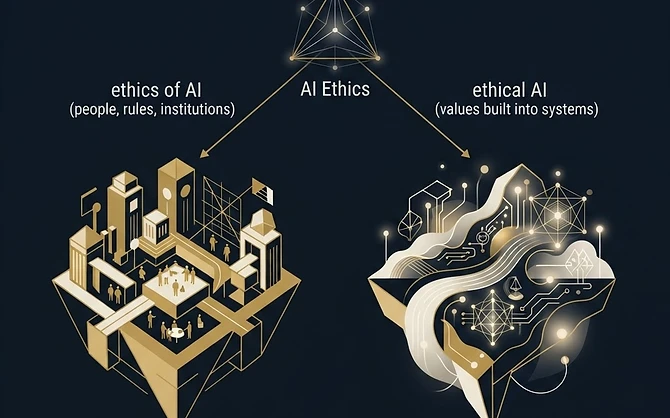
Ask what ethics in artificial intelligence is and most pages hand you one sentence and a list of buzzwords: fairness, transparency, accountability. The list is not wrong, but it tells you what the field worries about, not what the field is. This page gives the definition first, then the structure underneath it: the two meanings of the phrase, the three questions it keeps asking, where it stops and law or engineering takes over, and the criticism it has earned.
The short definition
Ethics, in the formulation of Oxford's Institute for Ethics in AI, is the study of the good and of how best to act in light of it. AI ethics applies that question to one technology: how AI should be designed, developed and used, given everything that is at stake, from welfare and justice to autonomy and human connection.
UNESCO's glossary definition puts it in institutional terms: the moral principles and standards governing the development and application of AI. A 2026 paper in AI and Ethics offers the most precise version so far: AI ethics is the systematic engagement with moral norms concerning AI systems, aimed at understanding those norms, communicating them, or applying them to AI systems.
Put plainly: AI ethics is the disciplined attempt to work out what AI ought to do, what people ought to do with it, and who carries the consequences.
Two meanings hiding in one phrase
The phrase is used for two related but different projects, and much confusion comes from mixing them. A survey in IEEE Transactions on Artificial Intelligence draws the line cleanly.
Ethics of AI: rules for the humans
The first sense covers the theories, guidelines, policies, principles and regulations that govern how people build and deploy AI. It is about developers, buyers, regulators and users. When a hospital debates whether to let a model triage patients, that is ethics of AI.
Ethical AI: values inside the machine
The second sense asks whether a system can itself uphold ethical norms and behave ethically. Stanford HAI defines ethical AI as systems designed, developed and deployed in line with human values, fairness, transparency and societal well-being. Research on machine ethics, the moral status of AI and responsibility for autonomous systems sits here, and the Stanford Encyclopedia of Philosophy treats it as one of the field's main open debates.
The IEEE survey makes the order explicit: the ethics of AI is the prerequisite for ethical AI. You cannot build values into a system before deciding which values, and that decision belongs to people.
The three questions AI ethics asks
Strip away the vocabulary and almost every argument in the field answers one of three questions.
What should be built at all
Some systems should not exist, or should exist only within limits. UNESCO's Recommendation opens its principles with proportionality: an AI system should not go beyond what is necessary to achieve a legitimate aim. Whether to automate a welfare fraud check, a parole decision or a weapons targeting loop is first an ethical question and only second a technical one. Oxford frames the same idea as deciding where AI can properly take over from humans and where things are best left to us.
How it should be built
Once a system is justified, the questions move into the work itself. The Royal Society organises them along the lifecycle: what biases sit in the training data, whether that data contains personal or copyrighted material, and whether the finished model can explain how it reached a conclusion. These are design choices made by engineers, often months before anyone outside the team sees the system.
Who answers when it goes wrong
The third question is responsibility. When an AI system harms someone, should the engineers, the company that built an app on top of the model, or the end user answer for it? The Royal Society calls these questions of liability contentious and unresolved. They are the bridge between ethics and law, and they are why what accountability in AI means has become a subject of its own.
How ethical theory applies to machines
AI ethics did not invent a new morality. It borrows the old ones and finds that they pull in different directions when applied to software.
A consequence lens asks what a system does to people's welfare: who gains, who loses, by how much. A duty lens asks whether the system respects people regardless of outcomes: whether they consented, whether they were deceived, whether they were treated as a means. A character lens asks what kind of developers and institutions we become by building and using it.
The research world already had a version of this before modern AI. IBM's explainer traces the field's foundations to the 1979 Belmont Report and its three principles for research on human subjects: respect for persons, beneficence and justice. IBM also notes their limit: they were written with human subjects in mind and long before generative AI, so they are foundational but not sufficient.
The Stanford Encyclopedia adds a warning that matters for anyone who equates AI ethics with risk management. Some ethical considerations are not about consequences at all, some harms are actual rather than probable, and an ethics that only lists dangers cannot describe a future worth wanting.
What AI ethics is not
Three neighbouring fields are routinely confused with it.
Not the same as law
Law is the part of ethics a state decides to enforce. IBM points out that while some regulation exists, such as the EU AI Act, many AI ethics guidelines remain voluntary frameworks written by scientists and industry. A practice can be legal and still be wrong, and an ethical expectation can exist years before any statute catches up. We set out the difference between AI governance and AI regulation separately.
Not the same as governance
Governance is the machinery an organisation uses to make its ethical commitments stick: committees, review gates, audits, documentation. Ethics supplies the reasons; governance supplies the procedure and the person who signs. Our piece on how AI ethics and governance fit together covers where one hands over to the other.
Not the same as AI safety
The Stanford Encyclopedia separates technical AI safety, sometimes called alignment, from AI ethics: closely related, societally important, but not identical. Safety asks how to make a system do what its designers intend. Ethics asks whether what they intend is right. Standards bodies sit at a third point again: ISO/IEC TR 24368 maps ethical and societal concerns around AI for technologists and regulators while deliberately not promoting any specific value system.
The four forms AI ethics takes
The 2026 AI and Ethics paper is useful because it stops treating AI ethics as one thing. It identifies four instances of the field and three purposes they serve.
- Research, mostly aimed at knowledge: philosophers and computer scientists working out what fairness or explainability should even mean.
- Education, aimed at communication: courses that teach engineers and policymakers to recognise an ethical question when it appears in their own work.
- Practice, aimed at application: an internal review that changes what data a model is trained on, or stops a launch.
- Governance instruments, also aimed at application: principles, codes, standards and recommendations, from corporate charters to UNESCO's text.
This also explains why the field draws on so many disciplines. The Stanford Encyclopedia lists philosophy and computer science alongside political science, economics, media studies, education, environmental studies and law.
Where the principles came from
Most people meet AI ethics as a list of principles, and there are many lists. When researchers at ETH Zurich mapped them in a 2019 Nature Machine Intelligence study, they found 84 documents containing ethical principles or guidelines for AI, 88% of them released after 2016. The lists converged on five principles: transparency, justice and fairness, non-maleficence, responsibility and privacy. They diverged sharply on how those principles should be interpreted, why they matter, and how they should be implemented.
Two years later UNESCO's Recommendation on the Ethics of AI, adopted in November 2021 by all 193 member states, became the first global standard on the subject, built on four core values and ten principles. If you want the frameworks side by side, see AI ethics principles compared, where the OECD, EU, UNESCO and Council of Europe texts are set against each other.
The honest criticism
A definition that leaves out the critics is a brochure. AI ethics has three serious ones.
The first is ethics washing. Lambrecht and Moreno argue that without a clear definition of the discipline, the field suffers from ethics washing and lobbying, dilution, conceptual bloating and an internal dispute about its own scope. A company can publish principles that cost nothing and change nothing.
The second is institutional fragility. The Stanford Encyclopedia notes that large AI firms typically had some form of ethics or safety committee, and that most were dismantled in the 2020s.
The third is the gap between principle and practice, which the Nature study already flagged: agreement on the words, disagreement on what they require.
The 2026 paper's answer is fair. Much of the criticism, it argues, assumes the field's only purpose is application, changing how systems are built and deployed. Research and education serve other purposes, and a failure in one instance does not discredit the rest. The stronger defence is the record: our article on why AI ethics is important walks through documented cases where the cost of ignoring it was paid by real people, and the same questions look sharper still in the ethics of AI in healthcare.
Where the definition gets tested
Definitions are easy to agree on in the abstract and hard to apply in a procurement meeting. EX Future Summit runs nine program tracks, including AI Ethics and AI and Society, next to tracks on government, health tech and finance, so the people who write principles share a room with the people who have to fund, regulate and ship systems under them. The summit runs on 18 to 20 November 2026 online and in Las Palmas and Bali, as a single thirty hour broadcast between the two islands, and online attendance is free for verified researchers and students.
FAQ
What is the difference between AI ethics and responsible AI?
AI ethics is the field of inquiry: what AI should and should not do, and why. Responsible AI is the practice that follows from it. ISO describes responsible AI as developing and using AI systems in a way that benefits society while minimising the risk of negative consequences, and notes there is no fixed, universally agreed set of principles behind it.
Is AI ethics a branch of philosophy or computer science?
Neither alone. Philosophy and computer science are its two largest sources, but it also draws on law, political science, economics and media studies, because most of its questions have a technical, legal and social side at the same time.
Is there one global definition of AI ethics?
No binding one. UNESCO's Recommendation is the closest thing to a global standard because every member state adopted it, while ISO's technical report maps the concerns without choosing values. Definitions in academic work keep evolving, as the 2026 attempt above shows.
Can an AI system be ethical on its own?
Researchers in machine ethics try to build norms into systems, so a system can be designed to behave in line with certain values. Responsibility for those values, and for the outcome, still rests with the people and organisations that choose to build and deploy it.