Summit
What Is the AI Liability Directive? The EU Plan, Explained
What is the AI Liability Directive? The EU's 2022 plan to ease AI harm claims, why it was withdrawn in 2025, and what governs AI liability now.
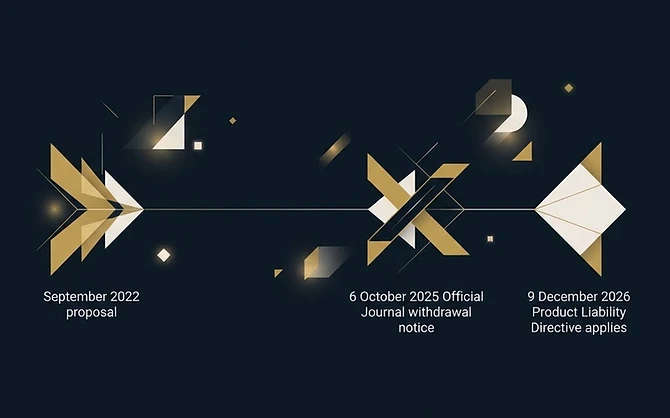
The AI Liability Directive was a European Commission proposal, filed as COM(2022) 496, to adapt national rules on non-contractual civil liability to artificial intelligence. Its purpose was narrow and practical: make it easier for a person harmed by an AI system to win compensation in court. It was never adopted. The Commission announced its withdrawal in February 2025 and the withdrawal was formally published in the Official Journal on 6 October 2025.
So if you are asking what the AI Liability Directive is in late 2026, the precise answer is what it was, and why the question has come back onto the floor of the European Parliament this month.
The short answer
| Official title | Directive on adapting non-contractual civil liability rules to artificial intelligence |
| Proposed by | European Commission, Directorate-General for Justice, September 2022 |
| What it targeted | Fault-based damages claims for harm caused by AI systems |
| Main tools | Court-ordered disclosure of evidence; a rebuttable presumption of causality |
| Status | Withdrawn, Official Journal notice of 6 October 2025 |
| Replacement | None tabled |
As Baker McKenzie summarises the consequence, there is for now no EU-level harmonisation of AI fault liability. Fault-based claims for AI damage revert to national tort law.
What the directive would have done
The problem the Commission set out to solve was evidential. A person harmed by an AI system usually cannot see inside it, cannot tell which of many companies in the supply chain made the decisive error, and cannot prove how a given output came about. National tort law asks the claimant to prove fault, damage and causation, and with an opaque system the last of those is often impossible.
The proposal answered with two procedural tools, both described in detail in the European Parliament Research Service briefing on the directive.
Disclosure of evidence (Article 3)
National courts would gain the power to order the disclosure of evidence about high-risk AI systems suspected of having caused damage: documentation, information and logs that the AI Act already requires providers to keep. Requests could go to the provider, to anyone subject to the provider's obligations, or to the user. The claimant first had to present enough facts to make the claim plausible and make proportionate efforts to get the evidence from the defendant. Courts could also order evidence preserved, and had to weigh trade secrets and confidential information.
The sanction was the interesting part. A defendant who ignored a disclosure order would be presumed to have breached the relevant duty of care. The presumption was rebuttable, but it changed the incentive to stonewall.
A rebuttable presumption of causality (Article 4)
The second tool linked fault to the AI output. If the claimant showed that the defendant breached a duty of care relevant to the harm, that it was reasonably likely this fault influenced the AI system's output (or its failure to produce one), and that the output caused the damage, the court would presume the causal link between the fault and the output.
The conditions tightened or loosened by risk class. For providers of high-risk systems, the relevant faults were breaches of AI Act requirements on training data, transparency, human oversight, accuracy, robustness and cybersecurity. For systems outside the high-risk category, the presumption applied only where proving causation was excessively difficult. A defendant could escape it by showing the claimant already had sufficient evidence and expertise to prove causation unaided.
What it did not do
Three limits are worth stating because they are often blurred in summaries.
- It did not reverse the burden of proof. The EPRS briefing is explicit: the Commission rejected a full reversal to avoid exposing providers and users to liability risks that could hamper innovation. The victim still had to prove fault and damage.
- It did not create strict liability. It sat on top of each member state's fault-based regime.
- It was minimum harmonisation. Member states could keep or adopt rules more favourable to claimants.
What it did have was reach. As Mason Hayes Curran notes, claims could be brought against any person whose fault influenced the AI system, not only the manufacturer, and for any damage recognised under national law, including discrimination and breaches of fundamental rights such as privacy.
Timeline: from proposal to withdrawal
| Date | Event |
|---|---|
| 28 September 2022 | Commission proposes the directive |
| 2022 to 2024 | Council working party discussions; Parliament suspends work until the AI Act is agreed |
| 19 September 2024 | EPRS complementary study recommends widening scope to general-purpose AI and moving to a software liability regulation |
| 11 February 2025 | Commission work programme lists the directive for withdrawal, citing "no foreseeable agreement" |
| 16 July 2025 | Commission approves the withdrawal |
| 6 October 2025 | Withdrawal published in the Official Journal, C/2025/5423 |
The Parliament's Legislative Train records the EPRS study and the opinion of the Internal Market committee, which judged the directive premature and unnecessary and asked the lead Legal Affairs committee to propose rejection. The Official Journal notice lists COM(2022) 496 among the withdrawn proposals and refers back to Annex IV of the February 2025 work programme for the reasons.
The politics of that decision are covered in our piece on why the AI Liability Directive was withdrawn. In brief, Bird & Bird records a lack of agreement on a final text and a wider push for regulatory simplification; the rapporteur, Axel Voss, warned at the time of a "Wild West" approach to AI liability.
What governs AI liability now
Withdrawal did not leave a vacuum. It left a patchwork with three layers.
The revised Product Liability Directive
The instrument that does now cover AI is Directive (EU) 2024/2853, published on 18 November 2024. Member states must apply it by 9 December 2026, six weeks from now. It extends no-fault product liability to software and AI, so a claimant needs to prove a defect, damage and the link between them, not negligence. It protects consumers and other natural persons, not businesses.
The Chambers 2026 practice guide notes two further changes: the old EUR 500 damages threshold is gone, and the directive brings in its own disclosure obligations to help claimants reach the evidence. In other words, some of the AI Liability Directive's tools now exist, but only for defective products and only for the injured person against the manufacturing side.
For how that plays out between developers, deployers and users, see our analysis of who is responsible for AI mistakes.
National tort law, and Italy's own rules
Everything the Product Liability Directive does not reach falls to national law, and national law differs. Italy has moved first. Legislative Decree No 160 of 9 September 2026, in force since 30 September, adapts Italian law to the AI Act and includes a chapter of civil procedural tools for compensation for damage caused by AI systems. It is not a transposition of the withdrawn directive, which never existed in law, but it addresses the same evidential problem in one member state. That is precisely the divergence the directive was meant to prevent.
The gaps that remain
A 2026 paper in the Cambridge Forum on AI: Law and Governance sets out what the product liability route cannot cover: pure economic loss and infringements of personality rights, which are exactly the harms AI tends to cause, and the user side of the value chain, since the directive targets manufacturers rather than deployers. It is also unclear whether "information" produced by an AI counts as a product defect at all. The author expects diverging national regimes to fill those gaps.
The gaps sharpen for autonomous systems, where the chain from a human decision to the harm is hardest to trace; we look at that in liability for AI agents. For organisations the practical response so far has been contractual and financial rather than legislative, which is why AI liability insurance has become a market of its own.
Is it coming back?
October 2026 reopened the file politically, if not legally.
On 6 October, POLITICO reported that OpenAI's chief executive Sam Altman had said "there's gonna need to be a liability framework for companies." Voss called it an "overdue moment of honesty" and urged Brussels to put liability back on the agenda. Brando Benifei called the withdrawal "a serious mistake." The Commission's answer was unambiguous: it "continues monitoring" the AI Act and the Product Liability Directive, and "at this stage, there is no plan to reintroduce a proposal on AI liability."
On 22 October the argument reached the plenary. Socialist and Green members called for a new AI Liability Act covering the testing and development of models. Swedish centre-right member Arba Kokalari answered that the EU already has a comprehensive framework in the AI Act and should focus on competitiveness. Commissioner Jozef Síkela closed by reminding the chamber that the rules were withdrawn because member states and Parliament could not agree.
That last point is the realistic forecast. Any successor would need the agreement that the 2022 text never found, and the coalition backing the Commission is split. Expect the near-term action to happen through the Product Liability Directive's application in December, national laws like Italy's, and the AI Act's own staged obligations, set out in our EU AI Act timeline.
Where the debate continues
Liability is one of the working questions for the Government and AI Ethics tracks at EX Future Summit, which runs 18 to 20 November 2026 as a single thirty-hour broadcast between Las Palmas and Bali. Policymakers drafting the next round of rules sit in the same programme as the researchers and operators those rules will govern. Online attendance is free for verified researchers and students.
FAQ
Is the AI Liability Directive in force?
No. It was a proposal that never completed the legislative process. The Commission's withdrawal was published in the Official Journal on 6 October 2025, so there is nothing for member states to transpose.
What is the difference between the AI Liability Directive and the Product Liability Directive?
The AI Liability Directive would have added procedural help, disclosure and a presumption of causality, to fault-based claims against anyone whose fault influenced an AI system. The Product Liability Directive imposes no-fault liability on manufacturers for defective products, and from 9 December 2026 that includes software and AI. The first was withdrawn; the second is law.
Does the EU AI Act cover liability for AI harm?
Not directly. The AI Act sets obligations for providers, deployers and authorities according to risk. Who must compensate a victim after harm occurs is a separate question, answered by the Product Liability Directive and national law.
Who proposed the AI Liability Directive?
The European Commission, through its Directorate-General for Justice under Commissioner Didier Reynders, in September 2022.