Summit
The AI Accountability Act Explained: H.R. 1694
The AI Accountability Act asks NTIA to study AI audits and disclosure. What the bill says, where it stands, and how it differs from the Algorithmic Act.
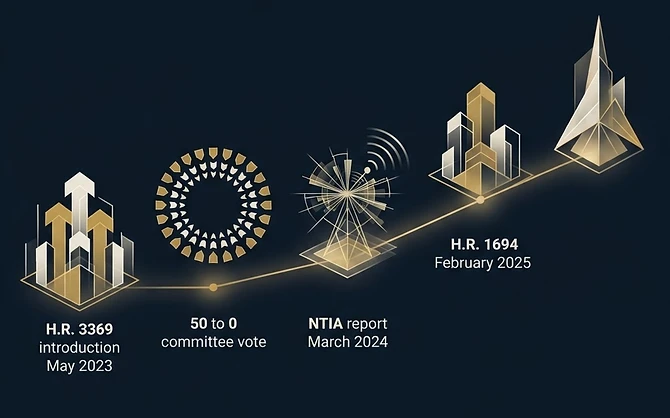
Search for the AI Accountability Act and you get the primary records: a congress.gov page, a committee report, a bill tracker. They are accurate. They do not tell you what the bill would change, why it has stalled twice, or why it is so often confused with a much more ambitious bill with almost the same name. This piece does that, in the order a researcher or founder would need it. ## The AI Accountability Act in one paragraph The Artificial Intelligence Accountability Act, short title the AI Accountability Act, is a US House bill sponsored by Representative Josh Harder of California, with Representative Robin Kelly of Illinois as cosponsor. In its current form, H.R. 1694 in the 119th Congress, it directs the National Telecommunications and Information Administration (NTIA) to study how AI systems can be held accountable, to hold public meetings on the question, and to report back to Congress. It regulates nobody directly. Its most consequential sentence may be a definition: an accountability measure is "a mechanism, including an audit, an assessment, or a certification, designed to provide assurance that a system is trustworthy." ## What the bill actually requires The bill text is five pages long and has two working sections. ### Section 2: a study of accountability measures NTIA's Assistant Secretary must study accountability measures for AI systems and analyse five questions: 1. How accountability measures are being built into AI systems used by communications networks, including telecommunications networks, social media platforms and spectrum sharing applications. 2. How those measures could help close the digital divide and promote digital inclusion. 3. How they might reduce risks from AI systems, including cybersecurity risks. 4. How the word "trustworthy" is used and defined in AI. 5. How "trustworthy" relates to neighbouring terms such as "responsible" and "human-centric". The agency must hold public meetings with stakeholders and, within 18 months of enactment, report to the House Energy and Commerce Committee and the Senate Commerce Committee with its findings, a description of the feedback, and recommendations for governmental and nongovernmental action. ### Section 3: what people should be told about AI systems The second section asks a narrower and more practical question. NTIA must consult industry, academia and consumers on what information should be available to the individuals, communities and businesses that interact with AI systems, are affected by them, or study them, and on the best methods for making that information available. A second report, on the same 18 month clock, carries the recommendations. ### What it does not require There is no obligation on developers or deployers, no enforcement agency, no penalty. The committee's own House Report 118-244 states that the legislation does not amend any existing federal statute and creates no new budget authority. Read plainly, the AI Accountability Act is a mandate to gather evidence before anyone legislates on the substance. ## Where the bill stands ### The 118th Congress: H.R. 3369 The bill first appeared as H.R. 3369, introduced on 16 May 2023. Its path through committee was unusually smooth. The House report records a subcommittee hearing on 23 May 2023 at which NTIA Administrator Alan Davidson testified, a subcommittee voice vote on 12 July, and a full Energy and Commerce Committee vote of 50 to 0 on 27 July. Representative Jay Obernolte, a California Republican, joined as a sponsor, and the amended bill was reported on 25 October 2023 and placed on the Union Calendar. It never reached the floor. GovTrack lists H.R. 3369 as having died in a previous Congress. Bipartisan, unanimous in committee and carrying no new budget authority, it still ran out of calendar. ### The 119th Congress: H.R. 1694 Harder and Kelly reintroduced the bill on 27 February 2025 with text that matches the 2023 committee version. The latest action listed on congress.gov is referral to the Energy and Commerce Committee on the day of introduction. GovTrack, which models every bill's odds, puts its chance of enactment at 2%, with one cosponsor. Obernolte's name is not on the 2025 version. ## NTIA already ran much of this study The odd fact about the AI Accountability Act is that its central task has largely been done. On 27 March 2024, acting on its own authority and drawing on public comments, NTIA published the AI Accountability Policy Report. The report treats accountability as a chain: information flows (documentation, disclosure, access) feed independent evaluation, which feeds consequences through regulation, market pressure or legal liability. Its recommendations cover exactly the ground the bill names. On audits, it asks federal agencies to create guidelines for AI audits and auditors, likely including auditor certification, and says audits should at minimum review risk mitigation, data quality and governance, documentation and disclosure, and process controls. On disclosure, it backs standardised baseline artifacts such as model cards, datasheets and "nutritional labels" for AI systems. On liability, it asks agencies to work out how existing rules apply. So what would the bill add? Three things the 2024 report does not have. A statutory mandate, which survives a change of administration in a way an agency initiative does not. A set of questions the report did not focus on, notably the digital divide, spectrum sharing and the vocabulary of "trustworthy" versus "responsible". And a deadline, with a report addressed to named committees that must then decide what to do with it. That is modest, and it is also why the bill draws little opposition. ## AI Accountability Act vs Algorithmic Accountability Act Much of the confusion around this search comes from a different bill. The Algorithmic Accountability Act of 2025 was introduced in the Senate as S. 2164 by Senator Ron Wyden on 25 June 2025 with seven cosponsors, and in the House as H.R. 5511 by Representative Yvette Clarke on 19 September 2025. It is a regulatory bill. Within two years of enactment the Federal Trade Commission would have to write rules requiring covered companies to run impact assessments of automated decision systems used in critical decisions, both before and after deployment, file annual summary reports with the Commission, keep the documentation for three years beyond the life of the system, and attempt to mitigate likely material negative impacts on consumers. | | AI Accountability Act | Algorithmic Accountability Act | |---|---|---| | Current bill | H.R. 1694 | S. 2164, H.R. 5511 | | Lead sponsor | Rep. Josh Harder | Sen. Ron Wyden, Rep. Yvette Clarke | | Agency | NTIA | FTC | | What it does | Study, public meetings, two reports | Mandatory impact assessments by rule | | Obligations on companies | None | Assessments, reporting, record keeping | | Support pattern | Bipartisan in 2023 | 29 cosponsors in the House, all Democrats | The first bill asks what accountability should look like. The second answers the question and writes it into rules. If someone tells you a US accountability act will require you to audit your model, they almost certainly mean the second one, and it has not passed either. ## What it means for researchers and founders For researchers, section 3 is the interesting part. It names people who study AI systems as a group whose information needs NTIA must consider, and it names academia among the stakeholders to be consulted. If the bill passes, the public meetings are a formal venue for arguing that researchers need access to model documentation and evaluation data, the same third party access the NTIA report already supports. For founders selling into the US, there is nothing to comply with today. The useful reading is directional. The four audit areas NTIA lists are a reasonable preview of what procurement teams and investors will ask about, and a company that can already document its data governance, risk controls and disclosures is ready for either bill. We compare the GAO, NIST, OECD and NTIA documents side by side in our guide to AI accountability frameworks, and set out the underlying concept in what accountability in AI means. For readers in Spain, Germany and the rest of Europe, the contrast is sharp. The EU AI Act is already binding law, and for prohibited practices it sets fines of up to 35 million euro or 7% of worldwide annual turnover. A European company that meets the AI Act's documentation duties will find little in either US bill that it has not already done. The difference between voluntary frameworks and binding rules is the subject of our piece on AI governance vs AI regulation, and the US federal argument over whether states may regulate AI at all is covered in the push to ban state AI regulation. ## Where this debate continues A study bill like this one depends on a conversation between the people who study AI systems, the people who build them and the people who write rules for them. EX Future Summit is built to put those three in one room: it runs 18 to 20 November 2026 as a single continuous broadcast between Las Palmas and Bali, with AI Ethics and Government among its nine tracks, and online attendance is free for verified researchers and students. ## FAQ ### Is the AI Accountability Act law? No. The 2023 version, H.R. 3369, passed committee 50 to 0 but never received a floor vote and died when the 118th Congress ended. The 2025 version, H.R. 1694, was introduced in February 2025 and referred to the Energy and Commerce Committee. ### Who sponsored the AI Accountability Act? Representative Josh Harder, a California Democrat, with Representative Robin Kelly of Illinois as cosponsor. Representative Jay Obernolte, a California Republican, joined the 2023 version before it was reported. ### Does the AI Accountability Act require AI audits? No. It asks NTIA to study audits, assessments and certifications as accountability measures and to recommend what government and industry should do. Mandatory impact assessments are in the separate Algorithmic Accountability Act. ### How is it different from the EU AI Act? The AI Accountability Act is a study bill with no obligations or penalties. The EU AI Act is binding regulation, with fines of up to 35 million euro or 7% of worldwide turnover for prohibited practices.