Summit
Deep Tech Investment Trends 2026: Capital, Sectors, Hubs
Deep tech investment trends in 2026: record megadeals, defence and quantum leading, a growth-stage gap, and where deal flow sits outside the big hubs.
Deep tech investment trends in 2026 are easy to summarise and hard to act on. Capital is at a record, it is concentrated in fewer rounds and fewer cities than ever, and the sectors receiving it are chosen by governments as much as by markets. The reports that rank for this phrase, from Dealroom, HTGF, PitchBook and KPMG, agree on the numbers. What they rarely do is say what those numbers mean for a researcher in Las Palmas, a policymaker in Jakarta or a seed investor who does not sit in San Francisco. This piece sets out the five trends the data supports, then looks at the geography the headline totals hide.
The headline numbers
Deep tech took 32% of all European venture funding in 2025, an all-time high and more than double its 15% share in 2015, according to the European Deep Tech Report 2026 that Dealroom produced with Lakestar, Walden Catalyst and Hello Tomorrow. The same report puts US deep tech funding at $144bn for 2025, up 92%, with AI model makers accounting for more than half of that total, while Europe grew 21% to $20bn. The UK attracted the most European money at $5.2bn, ahead of France at $3.9bn and Germany at $3.2bn.
The first half of 2026 has not slowed. Dealroom's live tracker shows $22.1bn raised by European deep tech startups in the first six months of 2026, which it annualises to $44.3bn, a 118% increase on 2025, with Q2 alone closing at $14.0bn. That full-year figure is a projection, not a closed quarter. Silverpeak, a European technology investment bank, counted a record $7.4bn of European deep tech financing in Q2 2026, up 93% on Q1, and a first half already ahead of the full years 2023 and 2024. The asset class has also proved stickier than software: the full report notes that deep tech funding sits only 4% below its 2021 peak, while regular tech remains 54% down.
Those are the totals. The five trends below are what sits inside them.
Trend one: the market is a barbell
The largest rounds now shape the averages. Over the trailing four quarters, the Dealroom tracker shows 66% of European deep tech capital landing in rounds of $100m or more, 24% in rounds between $15m and $100m, and 10% in everything under $15m. Seed has stopped meaning small. Ineffable Intelligence raised a $1.1bn seed round in April 2026 and Advanced Machine Intelligence a $1.0bn seed in February, both in the list of the fifteen largest European rounds of the last twelve months.
The pattern is sharper in defence. PitchBook reports $16.4bn of defence tech venture capital across 249 deals in Q2 2026, with autonomous systems taking 42.1% and Anduril's $5bn Series H at a $61bn post-money valuation leading the quarter. That was down 32.8% on a record Q1, yet still the fourth largest quarter on record, and trailing twelve-month investment reached $69.5bn. PitchBook's own title for the report is "go big or go early", and that is the practical reading of 2026: capital is available at the earliest stage, where technical conviction is cheap to buy, and at the proven-scale end. The middle is where rounds stall.
Even so, the medians are rising down the stack. Silverpeak measured median Series A size up 19% and Series B up 20% over the trailing twelve months, with Series C up 3%. Rounds are bigger. There are simply fewer of them in the middle.
Trend two: defence and sovereignty set the sector order
The clearest shift in allocation is defence. Walden Catalyst's reading of the Dealroom data is that defence and resilience have surged and now represent 43% of European deep tech funding, and the full report dates the climb from a 20% share in 2022. European defence startups raised a record $1.8bn in 2025, more than double the $792m of 2024, led by Helsing and the drone makers.
KPMG's Venture Pulse for Q2 2026 reads the same signal globally. Global venture investment was $227.4bn in the quarter, down from a record $332.9bn in Q1 that included a $122bn raise by OpenAI, and defence tech, biotech and fintech drew significant attention alongside AI, with Anduril's $5bn among the three largest deals in the world. KPMG expects defence to stay, in its words, quite hot into Q3. Deep tech now rides on the same megadeal engine as foundation model companies, which is why its totals and its concentration move together.
Policy capital is following. Zubr Capital's Q2 digest lists the EIF Defence Equity Facility 2.0 with an initial €1bn target, the EIC STEP Scale Up Defence call offering up to €30m per company, and a €1.07bn European Defence Fund injection across 57 projects. For a research team, the buyer and the funder of a dual-use technology are increasingly the same institution.
Trend three: quantum has gone institutional
Quantum is the sector where the character of the capital changed most. PitchBook recorded a record $3.9bn of quantum computing venture funding across 127 deals in 2025, with venture-growth investment jumping from roughly 1% of deal value in 2024 to 27.5%, and NVIDIA, BlackRock, JPMorgan and sovereign wealth funds now leading the largest rounds in place of specialist quantum firms. A single quarter, Q4 2025 at $1.5bn, exceeded the entire annual total of every year before 2021, and Q1 2026 opened an exit window with $5.7bn of liquidity across four transactions.
Europe participated rather than watched. In Dealroom's sub-sector ranking, quantum computing tops the momentum table, with venture capital up 193% over two years to $4.3bn in 2025 and 16 unicorns, and Oxford Quantum Circuits closed a $350m Series C in June 2026. Zubr adds Quobly's €115m Series A in France and QuantWare's €152m round with Intel Capital and In-Q-Tel in the syndicate. KPMG supplies the caution that matters for timing: the perceived time to commercialisation is longer than most technology plays outside biotech, and some investors are taking longer to decide. Quantum has institutional money. It does not yet have institutional patience.
Trend four: the growth-stage gap is a geography problem
The most repeated finding across the 2026 reports is the same one. Europe funds its own early stage and imports its growth stage. Dealroom finds that only 54% of funding for European deep tech rounds above $15m comes from within Europe, against 80% in the US, and that matching the US share would need another $4.0bn a year. The full report puts 70% of late-stage funding in the hands of non-European investors, sizes the annual gap at $4bn to $24bn, and notes that 40% of European deep tech unicorn founders either relocated to the US after founding or were already there. Silverpeak adds the sharpest version of the point: lead investors in deals of $100m or more came from just eleven countries, dominated by US and UK funds.
The structural reason is fund size. As Foundevo's summary of the report puts it, 87% of dedicated deep tech investor funds in Europe are under $300m, too small to lead a Series B, and the EU's €5bn Scaleup Europe Fund is only expected to begin operating in mid-2026. US strategic capital has noticed the opening. Zubr points to Qualcomm, Amazon and NVIDIA in Neura Robotics' Series C. When the next round sits on another continent, the company tends to follow it.
Trend five: the capital stack is hybrid
The last trend is about instruments rather than amounts. Deep tech hardware needs physical assets, and 2026 rounds increasingly wrap debt, grants and public guarantees around the equity. Zubr's digest records Nscale raising a further €670m for AI data centre infrastructure in Norway, ICEYE's €300m revolving credit facility, InSoil's €120m senior secured facility backed by an EIF guarantee under InvestEU, and Microamp's €6.5m EIC package split between a grant and EIC Fund equity. The same quarter saw the EIF and Poland's BGK commit €85m to three Polish funds for early-stage defence, dual-use technology and growth-stage AI, dedicated regional capital where there was previously little.
For a university spinout this matters more than any headline total. The Horizon Europe grant, the national innovation agency and the venture fund are no longer sequential. They are stacked into the same round, and the team that can read all three languages raises faster. Our guide on turning research into a commercial company covers that pathway from the lab side.
Where deal flow sits outside the tech capitals
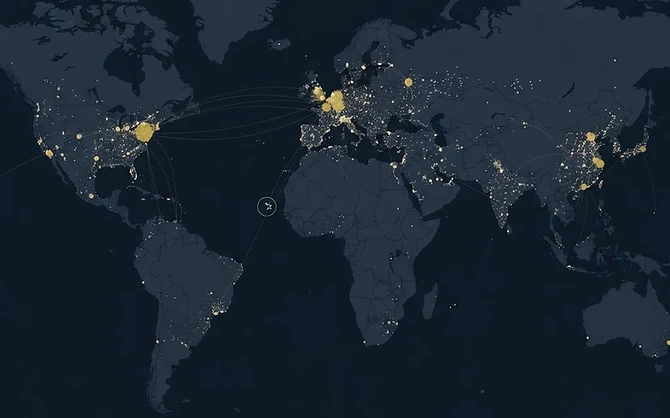
Every total above is dominated by a handful of cities, and the gap between where deep tech is built and where it is funded is the trend the reports underplay. The HTGF Global Deep Tech Report 2026 finds that Europe accounts for 45% of global deep tech startups but captures only 17% of global deep tech funding, and that the three largest funding hubs are San Francisco at $96bn, Palo Alto at $37bn and Stockholm at $25bn. Stockholm's total came from just 99 startups, which the report attributes to capital recycled from the Spotify and Klarna exits, Vinnova-backed R&D grants and a small home market that forces founders to build for export from day one. Cambridge raised $1.6bn from 82 startups, the same sum Berlin raised from 237.
That density gap is the opportunity. The share of the world's leading deep tech companies located in the top five regions fell from 44.4% to 41.2% in the 2025 DeepTech Index, Santa Clara Valley's share dropped from 24% to 20.4%, and Europe's rose from 13.6% to 18.6%. The same index names Nairobi, Lagos and Sydney as important hubs outside the three leading continents, counts five Indian urban regions with multiple world-leading deep tech companies, and lists Madrid among Europe's clean tech centres. Dealroom's Q2 2026 metro ranking has Barcelona in the European top ten at $352m, alongside Helsinki, Oulu and Rotterdam. Tech.eu's reading of the 2025 ecosystem data is that specialist ecosystems such as Munich, Kyiv, Athens and Sofia are accelerating, smaller centres like Ghent and Lausanne are becoming globally competitive, and Dealroom's founder singles out high-performing smaller ecosystems built around research institutions. In Asia, KPMG records Skyroot Aerospace's $60m round making it India's first spacetech unicorn in Q2 2026.
The pattern outside the capitals is consistent: a research institution, a public funder and a reason to build for the world market. None of these places will match San Francisco on volume, and they do not have to. The deals that get mispriced are the ones nobody from the large funds travelled to see.
What to do with this in 2026
For researchers, the stack is hybrid, so run the grant application and the investor conversation in parallel rather than in sequence. For how a fund will read your case, see the deeptech investment thesis from both sides of the table, and for the category itself, what deep tech investment is.
For investors, the barbell leaves the middle open, and the HTGF numbers say the under-funded startups are in Europe and in the secondary hubs. The question is how to find them without a local office.
For policymakers, capital follows sovereignty mandates, and a small jurisdiction can run a sandbox that reaches an international deal pipeline. Our piece on islands as regulatory sandboxes for AI sets out how.
That is the room EX Future Summit is built for. It runs 18 to 20 November 2026 across three rooms at once: online, Las Palmas in the Canary Islands, and Bali. The program includes a Global Financial Raise track mapping R&D capital across venture capital, private equity, national grants and Horizon Europe, and eight hosted meet-and-greet sessions matching universities with private partners. Bali Province's digital residency sandbox opens a cohort at the summit, with a ninety-day residency, a policy pilot lane and access to municipal data. Online attendance is free for verified researchers and students. It is a first edition and claims no track record. What it offers is deal flow from two islands that no funding ranking lists, in front of the researchers and regulators who can validate it.
FAQ
How much of venture capital goes to deep tech in 2026?
In Europe, 32% of all venture funding went to deep tech in 2025, a record, and the first half of 2026 raised $22.1bn, more than the whole of 2025. In the US, deep tech funding reached $144bn in 2025, with AI model makers accounting for more than half.
Which deep tech sectors are attracting the most investment?
Defence, security and resilience lead in Europe at 43% of deep tech funding, followed by AI infrastructure, quantum computing and robotics. Quantum has the fastest two-year growth, up 193% to $4.3bn in Europe in 2025, and global quantum venture funding hit a record $3.9bn the same year.
Is deep tech funding concentrated in a few cities?
Yes. San Francisco, Palo Alto and Stockholm are the three largest funding hubs worldwide, and Europe hosts 45% of deep tech startups but receives 17% of the funding. The concentration is easing slowly: the top five regions' share of the world's leading deep tech companies fell from 44.4% to 41.2% in the latest DeepTech Index.
Why is late-stage deep tech funding a problem in Europe?
Only 54% of European deep tech rounds above $15m are funded from within Europe, 87% of dedicated European deep tech funds are under $300m, and lead investors in rounds of $100m or more came from just eleven countries. Companies that cannot find a European lead raise abroad, and 40% of European deep tech unicorn founders now sit in the US.