Summit
Research to Commercialization: The Steps Nobody Budgets
The route from research to commercialization, priced. The FY2025 funnel numbers, the patent bill you now inherit, and the grants that fund TRL 4 to 6.
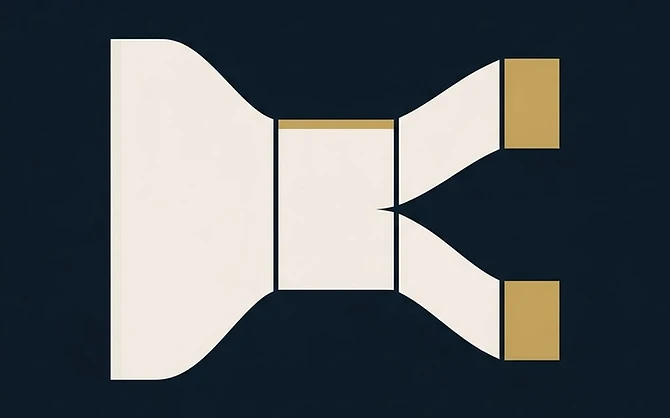
Almost every technology transfer office publishes the same diagram. Disclose, evaluate, protect, market, license, monitor. The diagram is accurate, and the route from research to commercialization really does run through those boxes in roughly that order. What the diagram never shows is the arithmetic: how many inventions survive each box, which invoices arrive at which stage, and who is expected to pay them once the institution has made its selection.
This article keeps the standard sequence and attaches the missing numbers to it.
The funnel is narrower than the diagram admits
Start with the shape of the pipeline at national scale. In fiscal year 2025, the research institutions reporting to AUTM recorded more than 112 billion dollars of research expenditure, 28,278 invention disclosures, 7,827 issued US patents, 10,277 licenses and options executed and 1,095 new startups formed, with 6,990 startups still operational.
Read the first and last figures together. Twenty-eight thousand disclosures produced roughly a thousand companies. Licenses and options are the more common outcome by an order of magnitude, and even there the ratio is roughly one in three, counting every category of license rather than patent licenses alone.
One institution states the survival rate outright rather than leaving it to be inferred. Vanderbilt's technology transfer centre notes on its own process page that about 1 in 5 of all technologies disclosed in academic institutions are licensed to industry, and that inventions lacking market potential to justify the cost of protection are closed.
None of this is an argument against disclosing. It is an argument for knowing which of the four steps below is the one likely to stop you, before you have spent two years finding out.
Step one: the evaluation clock, and the cost of being early
The first unbudgeted item is not money. It is the researcher's own calendar.
Evaluation is not a form. At Vanderbilt the licensing officer reviews the disclosure with the inventor in detail, then assesses market potential, patentability and development capability across a cursory assessment and an in-depth analysis, a sequence the office says typically takes about two months and often requires multiple discussions with the inventors. Two months of elapsed time, spread across a working group that still has grant deliverables and teaching to run.
Cambridge Enterprise is franker about how long the whole arc takes, describing a seven-step journey whose steps may run over weeks or years, and will often need to be repeated many times before you have enough information to convince a commercial partner to lead the development of your idea. Repetition, not progression, is the normal experience of this stage.
The one deadline inside step one is set by your own publication schedule. Guidance written for academic inventors is consistent on the point: talk to the transfer office before the work is made public, because leaving intellectual property protection until after publication can mean exposing yourself to expensive disputes or losing out to competitors working in the same field. A paper accepted before a filing decision has been made is the cheapest way to end a commercialization route, and it happens on a timetable the transfer office does not control.
Step two: the patent bill your institution is quietly handing back
Step two is where the process diagram is most misleading, because it draws protection as an institutional function and says nothing about the budget behind it.
That budget is tightening. In the same FY2025 survey where disclosures rose nearly 8 percent, new patent applications declined nearly 5 percent and foreign patent filings fell 40 percent, which AUTM reads as institutions concentrating limited resources where commercial potential is strongest. A 40 percent drop in foreign filings is a geography decision. It means a growing number of disclosures are protected in the United States and nowhere else, and that whoever wants European or Asian coverage will be arguing for it, or paying for it.
At the other end of the same logic sits the closure. Vanderbilt is explicit that patenting is an element of the commercialization process rather than a goal in itself, and that inventions it does not pursue are generally offered back to the inventors to pursue at their own expense, subject to an expectation that the inventor will actively pursue commercialization. That sentence is the single most consequential line on any technology transfer page, and it is where most commercialization budgets should begin.
What the SME Fund reimburses
For a spinout established in the European Union, there is a named instrument that changes the arithmetic on that bill. The EUIPO SME Fund reimburses 75 percent of filing and search fees for European patents filed at the EPO, 75 percent of pre-grant, grant and publication fees for national protection in a member state, and 50 percent of legal costs for drafting and filing a European patent application to a maximum of 1,500 euros, inside a per-SME ceiling of 3,500 euros for patent activity, split as 1,000 euros for national patents and prior art searches and 2,500 euros for European patents and legal costs.
Those are modest sums against a full international filing programme, and decisive ones against the first filing a spinout makes from its own bank account. The mechanism is reimbursement, not prepayment: the company pays the official fees, then claims. A summit partner has run the route in practice, with EnerGaia Institute securing 11 approvals from the EUIPO SME Fund to expand its IP portfolio in collaboration with EX-IX.
The part that is a queue, not a grant
The detail that no commercialization guide mentions is that the fund is finite and dated. The 2026 scheme runs from 2 February to 4 December 2026 and is open to SMEs established in the EU and Ukraine, with reimbursement paid directly into the company's bank account. It holds 18 million euros, of which 17.1 million sits behind the IP Scan, trade mark and design vouchers and only 900,000 euros behind the patent and plant variety vouchers, awarded first come, first served. As of the 2026 FAQ, Vouchers 1 and 2 were already unavailable for new applications because demand had exhausted them.
Demand at that level is not surprising. In 2025 the fund supported more than 33,000 SMEs with almost 29 million euros. Treat the scheme as a queue with a calendar, not as a subsidy that will be there when the science is ready.
Step three: the TRL gap has two named grants and a retrospective eligibility test
Between a result validated in the lab and a package a company will license sits the gap that kills most projects. There is money written specifically for it, and the eligibility rules matter more than the amounts.
EIC Transition is the instrument for that band. Its 2026 budget is 100 million euros, it awards grants of up to 2.5 million euros to validate and demonstrate technology in an application-relevant environment starting at TRL 3 completed or TRL 4 and aiming at TRL 5 or 6, and it offers booster grants of a fixed amount not exceeding 50,000 euros to explore commercialization pathways. The condition attached is the part to read first: the proposal must build on results already achieved within an eligible earlier project, meaning EIC Pathfinder, an ERC Proof of Concept, or a Horizon Europe Pillar II or Research Infrastructures project, and proposals building on results at other technology readiness levels are not eligible.
Eligibility is therefore retrospective. Whether this door is open to you was decided years earlier, by which programme funded the bench work, which is a strong argument for reading the funding pathway backwards from the instrument you will eventually need. Downstream, the EIC Accelerator carries a 634 million euro budget in 2026, with a grant component below 2.5 million euros and investment from 0.5 to 10 million, for companies already past demonstration. The sequencing is the point, and it is the same reasoning that governs what Horizon Europe funding actually approves.
Step four: the one input no process diagram can generate
The final step is the one every diagram draws as a box and no institution can manufacture on demand: a specific person at a specific company who wants this technology enough to sign for it.
Look again at how the marketing stage actually works. The licensing officer identifies and approaches companies in relevant markets, shares details under confidentiality agreements, and arranges scientific discussions between those companies and the inventors, which Vanderbilt describes as often a key factor in generating market interest. The mechanism is introductions and conversations. Cambridge's formulation is the same one from the other direction: the steps repeat until there is enough evidence to convince a commercial partner to lead.
Patents do not produce that partner. Grants do not produce that partner. What produces one is a room containing researchers, companies, funders and, for regulated sectors, the people writing the rules, which is a structural argument rather than a marketing one and applies equally to how the good university industry collaborations are structured.
It is the reason the EX Future Summit builds its programme around that room rather than around a stage. The event runs nine tracks, including a Global Financial Raise track covering venture capital, private equity, national grants and Horizon Europe, alongside eight hosted meet-and-greet sessions that match universities with private partners. It takes place from 18 to 20 November 2026 as a single continuous thirty-hour broadcast across Las Palmas, Bali and online, with free online attendance for verified researchers, students and the EX community. For a research team whose main missing input is a counterparty rather than a patent, that is the relevant test to apply to any event, and the same test worth applying when deciding what to look for in an AI business summit.
FAQ
Who owns the invention if my university decides not to patent it?
Institutions close cases when the market potential does not justify the cost of protection. Vanderbilt's policy is that inventions it does not pursue are generally offered back to the inventors to pursue at their own expense, subject to conditions including an expectation that the inventor will actively pursue commercialization. Policy is institution-specific, so the only authoritative answer is your own institution's technology policy.
Can a university apply to the EUIPO SME Fund, or only a company?
The scheme funds small and medium-sized enterprises established in the European Union and Ukraine, and reimbursement is transferred directly to the SME's bank account. In a spinout structure that means the company applies and claims, not the research institution.
Do I need a previous EU grant before applying to EIC Transition?
Yes. The proposal must build on results already achieved within an eligible project at TRL 3 completed or TRL 4: EIC Pathfinder, an ERC Proof of Concept, or a Horizon Europe Pillar II or Research Infrastructures project. Results at other readiness levels are not eligible, so the prior project is a gate rather than a preference.
Does publishing my paper first rule out a patent?
It frequently does, and it is the most common self-inflicted failure at this stage. Guidance for academic inventors is to involve the transfer office before the discovery is made public, because leaving protection until after publication risks losing the position to competitors working in the same field.