Summit
AI Liability Insurance: What Underwriters Now Cover
AI liability insurance in 2026: the exclusions that removed cover, the specialist policies replacing it, and how to read a wording before you buy.
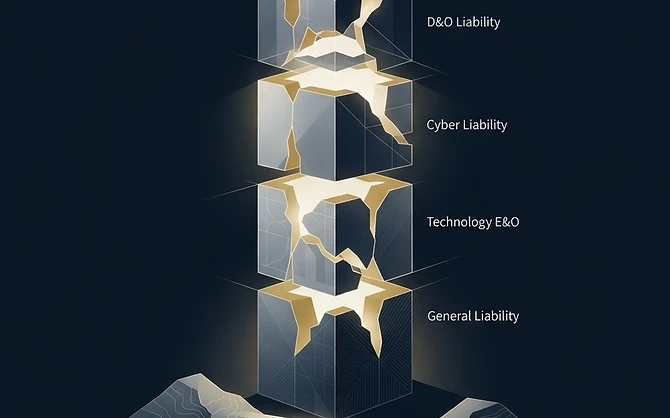
For most of the past decade, nobody bought AI liability insurance because nobody needed to. A chatbot that defamed a customer or a model that gave a client bad advice would, in principle, land on a policy the company already held: general liability, technology errors and omissions, cyber. The policies did not mention AI, and what a policy does not exclude, it may cover.
That arrangement has a name in the trade, "silent AI", and according to Fenwick it is ending. Insurers are writing AI out of the policies that used to carry it, quietly in some cases, and a small specialist market has appeared to write it back in, for a price and on its own terms. This piece maps both sides: what was removed, which policy still responds to which harm, and how the new products differ in what makes them pay.
It follows on from our pieces on liability for AI agents and who is responsible for AI mistakes. Those ask who owes the money. This one asks who actually pays it.
What AI liability insurance is, and why it suddenly exists
AI liability insurance is cover that names AI failures affirmatively: hallucinated outputs, model error and drift, infringing or defamatory content, data leaking through an output, an agent taking the wrong action. Its reason for existing is mostly negative. It fills holes the rest of the market has started to cut.
The decisive cut came from the Insurance Services Office. In January 2026 Verisk/ISO, whose standard forms appear in more than 80 percent of US property and casualty policies, published exclusion language that carriers can attach to remove generative AI losses from general liability, as RAND's report on the insurability of AI sets out. The forms are optional. The carriers using them are not small.
Fenwick's observation is that this is the path cyber risk took ten years ago, silent cover followed by exclusions followed by standalone products, only compressed and more fragmented. Renewals in 2026 are where most companies will discover which stage their own programme has reached.
What the exclusions took away
The ISO generative AI forms
There are three forms, and they do different things. The summary from 4BusinessInsurance:
| Form | What it removes |
|---|---|
| CG 40 47 | Bodily injury, property damage, and personal and advertising injury arising out of generative AI (Coverages A and B) |
| CG 40 48 | Personal and advertising injury arising out of generative AI (Coverage B only) |
| CG 35 08 | Bodily injury and property damage from generative AI under products and completed operations |
The forms define generative AI broadly, as a machine-based system trained on data that can create text, images, audio, video or code. The same guide cites Insurance Business reporting, on 16 September 2026, that 2,369 generative AI exclusion records were in force across 49 states.
The Berkley absolute exclusion
ISO's forms touch general liability. W. R. Berkley went further on its own paper, adding an exclusion to directors and officers, errors and omissions and fiduciary liability products that bars any claim arising from "any actual or alleged use, deployment, or development of Artificial Intelligence by any person or entity". RAND reproduces the clause in full. It reaches AI-generated content, a failure to detect someone else's AI content, inadequate AI policies or training, AI-enabled products, promises made by a chatbot, a company's own public statements about AI, and the cost of responding to a regulator's demand to assess AI risk.
That last pair matters to boards. A securities claim built on what a company told investors about its AI strategy is exactly the claim a D&O policy exists for, and under this wording it is gone.
Who is adopting them
Dark Reading reports, citing Insurance Business, that Chubb, Travelers, Berkshire Hathaway, AIG and W. R. Berkley are among the carriers adopting the ISO endorsements.
Which policy responds to which AI harm
The practical problem is that AI losses do not arrive labelled. The same hallucination can be a professional error, a defamation, a data disclosure or a bodily injury depending on who relied on it and what happened next. Here is how the lines divide, on current market practice:
Commercial general liability. Responds, absent an exclusion, to bodily injury, property damage, and advertising injury such as defamation or copyright in marketing. It does not cover first-party loss or pure financial loss from a wrong answer, and with CG 40 47 attached it covers none of the AI version of those harms.
Technology E&O. Covers third-party financial loss from failures in technology a company supplies. Gallagher Re makes the point most buyers miss: it is built for suppliers of technology, so it suits the AI developer selling a tool and generally does not suit the bank, retailer or hospital that merely uses one.
Cyber. Built around intrusion. Dark Reading's sources draw the line at the non-malicious failure: a model that leaks data without any attacker, or an agent that pulls in data that then has to be purged, may sit outside a cyber trigger. Beazley sells what its emerging risk lead calls "AI voluntary shutdown coverage" for that second case.
D&O and employment practices. Fenwick describes each line narrowing independently, which creates gap risk: no one policy is wrong on its own, but a claim can fall between all of them. Employment is the obvious exposure, since automated hiring screens generate discrimination claims. Sector rules sharpen the problem further, as in AI liability in healthcare, where clinical tools meet malpractice cover.
Contract. Most companies assume their AI vendor carries the risk. Honigman reports that most AI vendor agreements cap total liability at twelve months of fees and that the vendor's own E&O often excludes AI, so the indemnity may have nothing behind it. In Honigman's words, most AI liability ends up on the enterprise's own balance sheet.
The specialist market: two ways to underwrite AI
Gallagher Re identifies two underwriting philosophies among the standalone products, and the distinction is the most useful thing a buyer can learn, because it decides what has to happen before the policy pays.
Performance-triggered cover
Here the insurer measures the model. Munich Re's aiSure, which Gallagher Re credits with pioneering the concept, is a performance warranty and guarantee product: the insurer assesses the model, agrees a threshold, and pays when the error rate breaches the agreed baseline. RAND lists the losses it addresses as underperformance, hallucination and false information, privacy leakage and IP infringement by models trained on protected material. Because the insurer tracks performance over time, this approach can cover gradual degradation such as model drift. The cost is a heavier underwriting process.
Armilla, a Lloyd's coverholder backed by Chaucer and Axis Capital, works in this tradition. According to Beinsure, it raised limits in January 2026 to $25 million per insured and extended cover to AI agent failures, including incorrect decisions, improper tool use and escalation errors, plus defence costs and insurable fines in investigations under the EU AI Act and the Colorado AI Act. RAND notes that Armilla writes per model rather than per enterprise, with up to $5 million per model use, and that it also sells performance guarantees that let an AI vendor insure the hallucination rate it promises a customer.
Litigation-triggered cover
Here the insurer waits for a lawsuit. Testudo, launched in January 2026, sells a claims-made third-party policy to US companies that deploy generative AI, with no pre-deployment model assessment. Its own summary is refreshingly exact about the limits:
- Six insuring agreements: output error, IP infringement and defamation, unauthorised data disclosure, bodily injury, property damage, and a supplemental regulatory agreement.
- A $2 million sub-limit per agreement and a $10 million aggregate, with defence costs eroding the limit.
- Cover attaches only to the AI systems and business activities named in the schedule.
- It covers systems the insured deploys, not ones it builds, trains or licenses to others.
- It excludes cyber attacks, first-party loss, discrimination claims, patents and trade secrets, and biometric data.
The company itself warns that saying it "covers AI" overstates the contract. That sentence should be on every buyer's desk.
Comparing the products
| Product | Built for | Pays when | Headline limit |
|---|---|---|---|
| Munich Re aiSure | Developers giving warranties; large deployers | A model misses an agreed performance threshold | Not published |
| Armilla (Lloyd's) | Developers and deployers, including agents | Specified underperformance causes a claim | $25M per insured |
| AIUC | Similar in shape to tech E&O | First and third-party AI loss, including agent tool-call failures | Up to $50M |
| Testudo | US deployers of generative AI | A third party sues over a scheduled system | $10M aggregate |
The AIUC figures come from RAND, which describes the policy as functionally close to tech E&O but with affirmative cover for agent losses such as incorrect payments and refunds. On the programme side, 4BusinessInsurance reports that Mayflower Specialty and Hadron announced in June 2026 what they called the first dedicated affirmative AI liability programme in the US, combining E&O, EPL and D&O with a difference-in-conditions and excess layer. The same guide adds a sober note: Insurance Business found no admitted standalone product that replaces the general liability cover the exclusions remove.
No source we found publishes premium rates, and we will not guess at them.
The European angle: product liability from 9 December 2026
US forms dominate this conversation, but the larger shift in exposure for anyone selling AI into Europe is a statute. The revised Product Liability Directive, Directive (EU) 2024/2853, must be applied by member states by 9 December 2026, four weeks from today. It extends no-fault product liability to software and AI, so a claimant proves a defect, damage and the link between them, not negligence.
That is the instrument that took the place of the AI Liability Directive, which Brussels withdrew. For insurers it converts a negligence argument into a defect argument, which is easier to win and therefore more expensive to cover. It also explains why the newer wordings mention regulatory fines and the EU AI Act by name. Readers working through obligations rather than cover will find the rules side in our guide to AI regulatory compliance.
Questions to put to a broker before you buy
The products are young and the wordings differ more than the marketing does. Cowbell's chief executive, quoted by Dark Reading, framed the test well: does the wording address a non-malicious system failure, and does it address a disclosure with no external intrusion? From the sources above, the questions that decide a claim are these:
- What exclusions are on my current tower? Check the general liability policy for CG 40 47, CG 40 48 or CG 35 08, and the D&O and E&O for any carrier-specific AI clause. Fenwick warns that erosion can sit in revised base forms and definitions, not only in a labelled exclusion.
- Am I a developer or a deployer, per system? Testudo applies the test system by system, and Tech E&O only suits the supplier side.
- What is the trigger? A performance breach, a lawsuit, or both. Performance triggers catch drift; litigation triggers need no model audit.
- Which systems are scheduled? A system added after inception may need an endorsement before it is covered.
- How does the policy decide a loss was "caused by AI"? 4BusinessInsurance flags this causation wording as the clause to read first.
- Do defence costs erode the limit? In Testudo's wording they do.
- Where commercial markets will not go, what is the alternative? Fenwick lists manuscript endorsements, captives and difference-in-conditions layers.
EX Future Summit runs Finance, AI Ethics and Global Financial Raise among its nine program tracks, from 18 to 20 November 2026, which puts founders, investors and policymakers in the same sessions. An insurer pricing AI risk and a founder trying to buy cover are, for once, asking the same question: what exactly can go wrong, and who can prove it.
FAQ
Does general liability insurance cover AI mistakes?
It may, if no AI exclusion is attached. Since January 2026 carriers can attach ISO forms that remove bodily injury, property damage and advertising injury arising from generative AI, and several of the largest carriers are doing so. Pure financial loss from a wrong answer was never a general liability risk in the first place.
Does cyber insurance cover AI hallucinations?
Usually not. Cyber policies are written around attacks and breaches. A hallucination that causes a client loss is a professional error, which points to tech E&O if you supply the AI, or to a specialist AI policy if you only use it.
How much AI liability cover can a company buy?
Published ceilings range from a $10 million aggregate at Testudo to $25 million per insured at Armilla and up to $50 million at AIUC. Sub-limits per type of harm are often much lower, and defence costs can count against them.
Can AI regulatory fines be insured?
Only where the law allows fines to be insured, which varies by country. Some specialist wordings include defence costs and insurable fines for actions under AI laws, but they exclude anything not insurable by law.