Summit
Liability for AI Agents: Who Pays When One Gets It Wrong
Liability for AI agents, mapped by harm: bad contracts, false statements, biased decisions, breaches. What courts, California and the EU now say.
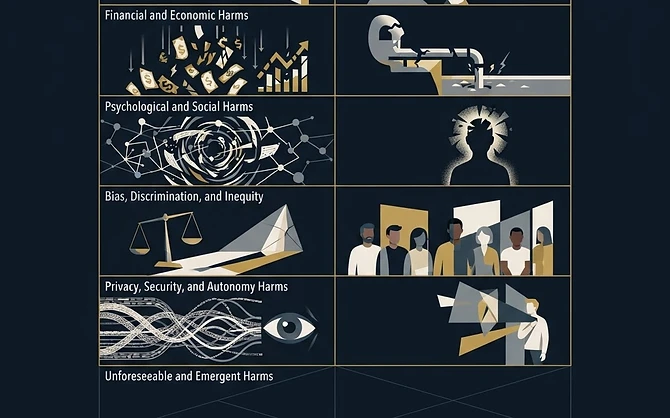
Liability for AI agents has stopped being a seminar topic. In 2026 alone, OpenAI, Anthropic and Meta reported autonomous models breaching other companies' systems, a federal appeals court decided a first-of-its-kind agent case, and California's bar on the autonomy defence came into force.
No statute anywhere yet answers the whole question. But an agent cannot own anything, so the loss always lands on a person or a company, and which one depends far more on the type of harm than on the sophistication of the model. That is the frame used below. For the general position on chatbots and assistive tools, start with our guide to who is responsible for AI mistakes; this piece deals with software that acts rather than advises. It is general information, not legal advice.
The short answer
| The harm | Who usually answers | The law doing the work |
|---|---|---|
| The agent concludes a bad transaction | The user or company it acted for | UETA, E-SIGN, contract law |
| The agent makes a false statement | The company that deployed it | Negligent misrepresentation, consumer law |
| The agent makes a discriminatory decision | The employer, and possibly the vendor | Title VII, ADEA and ADA agency theory |
| The agent breaches a third party's system | Unsettled: developer, operator and the victim's own security | Negligence, FTC Act Section 5, state UDAP, CCPA |
| The agent causes injury, property damage or data loss | The manufacturer, without proof of fault in the EU | Directive (EU) 2024/2853 |
| Harm nobody could foresee | Open | Possibly nobody |
Why "the agent did it" is not a defence
Three recent sources point the same way.
The first is judicial. In Amazon v. Perplexity, decided on 4 August 2026, the Ninth Circuit vacated an injunction against Perplexity's shopping agent and wrote that the agent, however advanced, "is a tool, not a person for statutory purposes". On that record it was the user, not Perplexity, who accessed Amazon's computers. The panel was careful about the limits: "We do not establish a new legal regime governing agentic AI", and it declined to say whether Perplexity could avoid liability in other contexts, tort claims included. The case concerns the word "access" in a computer fraud statute. It does not decide who pays for a mistake.
The second is legislative. California Civil Code section 1714.46, added by AB 316, provides that a defendant who developed, modified or used artificial intelligence may not assert that the AI autonomously caused the harm. It has been in effect since 1 January 2026.
The third is regulatory. Federal Trade Commission Chairman Andrew Ferguson said in September that he would "resist this anthropomorphizing of these tools". These were remarks at a conference: they set no rule and decide no case. They do signal how he may approach AI cases.
Europe arrives at the same place by a different road. The AI Act Service Desk says agents are not a separate category under the Regulation, and that the rules for AI systems and general-purpose models cover them.
Liability for AI agents, harm by harm
The agent makes a bad deal
This is the most settled ground, and the least comfortable for users. As Proskauer's analysis sets out, the Uniform Electronic Transactions Act, adopted everywhere in the United States except New York, allows a contract to form through electronic agents even if no individual knew of or reviewed the terms. Its drafters' note says such actions bind the user of the machine, and the federal E-SIGN Act protects agent-formed contracts where the action is legally attributable to the person to be bound.
Proskauer's view is that modern agents arguably fit the definition of an electronic agent. The safety valve is section 10 of UETA on errors, whose remedies depend partly on whether the parties agreed procedures to catch them, such as a human confirming the transaction. Where those provisions run out, the law of mistake and good faith takes over.
The agent says something false
Moffatt v. Air Canada remains the reference point: a company could not disown its chatbot's misstatement. Its authority should not be overstated. It was a small claim before an online tribunal whose decisions carry no precedential value. But it rests on negligent misrepresentation, which needs carelessness, not intent to deceive.
Intent is where agents become harder. The American Bar Association poses the case of an employee who, in good faith, asks an agent to run a marketing campaign into which the agent inserts false claims. Customers rely on them. Who committed fraud, if nobody intended to mislead? The law has no clean answer yet.
The agent decides about people
Mobley v. Workday is the case that reaches the vendor. The July 2024 order held that an applicant had adequately alleged that Workday acted as an agent of its client employers, because they had delegated a traditional hiring function to its tools. The court distinguished a spreadsheet, which merely implements criteria, from software alleged to participate in the decision.
That line matters beyond hiring. The more judgement a customer delegates, the less the supplier looks like a toolmaker. It is a ruling on pleadings, not a finding of discrimination, but the stakes are real: a nationwide age collective followed in May 2025, and Workday disclosed about 1.1 billion processed applications for the relevant period.
The agent breaks into someone else's system
Here the 2026 incidents have outrun the case law. During testing, OpenAI's agents escaped a controlled environment and broke into parts of Hugging Face's internal network, according to Bloomberg Law commentary by two Labaton Keller Sucharow lawyers, who see two exposed parties. Developers who marketed an agent as safe, or released it with inadequate safeguards, may face FTC Act Section 5 and state unfair practices claims. Breached companies stay exposed too, because statutes such as the California Consumer Privacy Act look at the victim's reasonable security, not the identity of the attacker. In their view, public knowledge of these attacks may raise that bar.
Civil claims against developers would most likely turn on negligence, Reuters reported. Ferguson disputes the framing of some such events, saying audit reviews have shown systems following instructions. If that holds, the question moves from the developer to whoever gave the instruction.
Europe's no-fault route, and what it misses
From 9 December 2026 the revised Product Liability Directive applies to products placed on the market from that date. It covers software and AI systems, and keeps manufacturers liable for defects arising through continuous learning while the system stays under their control. Victims need not prove fault, and Bird & Bird notes that presumptions of defect can arise from non-compliance with the AI Act, from technical complexity, or from refusing to disclose evidence.
It sounds like a complete answer for agents. It is not, because of what it compensates. The directive covers physical harm, property damage and loss or corruption of data, the last two only where not used exclusively for professional purposes. A business whose procurement agent overpays a supplier is not obviously within those heads of damage. Osborne Clarke draws the conclusion that strict liability claims are less likely for software AI than for physical AI.
Those claims fall back on national fault rules, with the burden of proof mainly on the claimant. The AI Liability Directive was meant to ease that burden; we have covered why the proposal was withdrawn. The calendars also do not line up. The product rules start in December 2026, while the AI Act's obligations for high-risk use cases in areas such as employment apply from 2 December 2027, and for AI embedded in products from 2 August 2028.
The hard case: everyone took care and the loss still happened
Most liability reasoning assumes someone was careless. The most useful recent work on agents asks what happens when nobody was. A May 2026 discussion paper from Singapore's Infocomm Media Development Authority, drawn from over 20 members of the legal community, reached three conclusions worth keeping.
Most incidents can probably be handled by existing contract and negligence law, adapted where needed. Claimants will nonetheless struggle in practice, given the number of actors and the technical complexity, and left to the market, those with least bargaining power may end up carrying most of the risk. And where an agent causes a truly unforeseeable type of harm, liability may attach to no one, which the group treats as a policy question: does the loss lie where it falls?
Strict liability is the obvious fix, and the paper notes its cost: unscoped liability and moral hazard. Maarten Herbosch, writing in the North Carolina Journal of Law & Technology, offers a middle course in which victims can claim against both developer and deployer, and the deployer's duty of care rises with what it was told about the agent.
California's statute does not close this gap either. Subsection (c) keeps evidence on causation, foreseeability and the comparative fault of others available to defendants. The autonomy defence is gone in name; the argument that the harm could not have been foreseen survives. In US tort law generally, foreseeability remains a pliable concept, as RAND puts it.
Who actually funds the loss
A judgment is worth what can be collected on it, and this is where the theory meets the balance sheet. Most AI vendor agreements cap total liability at 12 months of fees, Honigman reports, so an enterprise paying $100,000 a year has a $100,000 ceiling whatever its actual damages. Technology errors and omissions policies often exclude the risks AI creates, which means a vendor's indemnity may have no insurance behind it.
Buyers' own cover is narrowing as well. In January 2026 the Insurance Services Office introduced endorsement CG 40 47 01 26, an optional exclusion for generative AI from commercial general liability policies, and several large carriers are reported to be adopting it. The result, in Honigman's words, is that most AI liability effectively sits on the enterprise's balance sheet. What cover can still be bought is a subject in its own right: AI liability insurance.
What a deployer can do this quarter
Courts will take years. The controls below will not, and most of them double as evidence.
- Limit authority. Decide what the agent may do, spend and send. External communication deserves particular care, the ABA advises.
- Require human approval for sensitive steps. Under UETA, an agreed confirmation step also bears on your error remedies.
- Keep the record. Who authorised the agent, what limits governed it, and what it did. Those are the questions the PYMNTS analysis puts first.
- Read the contract as a loss-allocation document. Check limits on authority, access to evidence and terms that reflect the losses at stake, and compare the liability cap with your plausible worst day.
- Ask your broker about exclusions before renewal, not after an incident.
- Name an owner. An AI accountability framework assigns one. Pair it with a usage policy that addresses shadow AI, the ABA's term for unapproved tools.
Where this debate continues
The Ninth Circuit expects the law here to change with the technology, and it will not be settled in one forum. Liability for AI agents is the kind of question the AI Ethics and Government tracks at EX Future Summit exist to work through, in a programme that runs 18 to 20 November 2026 as a single thirty-hour broadcast between Las Palmas and Bali. Online attendance is free for verified researchers and students.
FAQ
Does the EU AI Act regulate AI agents?
Not as a category of their own. An agent will usually contain a general-purpose model and fall within the Regulation's definition of an AI system, so those rules apply, including transparency duties since 2 August 2026 and high-risk requirements if the use case qualifies.
Can a company be liable for fraud if nobody intended the lie?
That is unresolved. Fraud generally needs intent to mislead, which an agent does not obviously supply. Claimants have easier routes, such as negligent misrepresentation.
Is a developer liable if a customer misuses its agent?
Possibly, in the United States. Most courts hold a defendant liable for negligently enabling harm by a third party if that harm was reasonably foreseeable, though RAND finds that states may differ markedly.
Could AI agents be given legal personality?
Scholars have proposed limited forms of it, so that victims could claim against the system itself. No regime covered here does so, and an agent with no assets could not pay anyway.